Agree on one page where your team is heading and how each person's work gets it there.
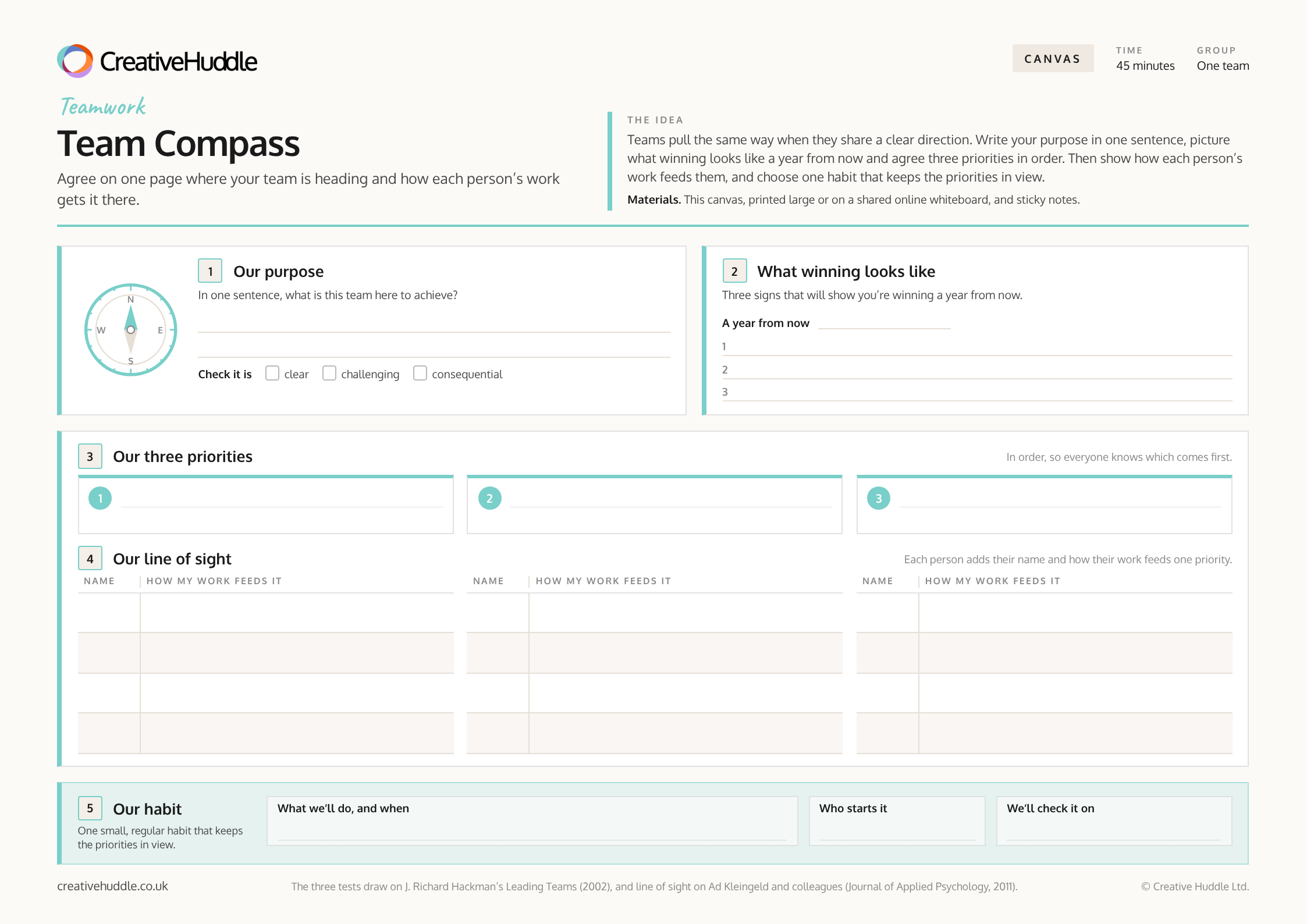
The Team Compass is a one-page record a team builds together of where it's heading. It has five boxes: our purpose, what winning looks like, our three priorities, our line of sight and our habit. It suits any team that wants everyone pulling the same way.
Trusted by teams at


Teams pull the same way when they share a clear direction. The Team Compass helps a team agree where it's heading and see how each person's work gets it there.
Purpose comes first. J. Richard Hackman found that a compelling direction is one of the conditions that help teams do well, and he set out three tests for it: clear, challenging and consequential (Leading Teams, 2002). The team writes its purpose in one sentence and checks it against all three.
The next stage is to turn the purpose into goals: three signs the team will see a year from now, and three priorities in order. Edwin Locke and Gary Latham's review of 35 years of research found that specific, challenging goals lead to higher performance better than vague ones such as "do your best", as long as people are committed to them and get feedback on progress (American Psychologist, 2002).
Line of sight shows how each person's work feeds one priority. A review by Ad Kleingeld, Heleen van Mierlo and Lidia Arends found that group goals raised group performance, and specific, difficult group goals did best (Journal of Applied Psychology, 2011). Individual goals set to help the group lifted performance too.
The page closes with one small, regular behaviour that keeps the priorities in view. A quick check at the start of each team meeting gives the team regular feedback on progress.
Use the Team Compass when a team wants to agree where it's heading and see how everyone's contribution gets it there. The team writes its purpose, pictures winning, agrees priorities in order, shows each person's line of sight and sets one habit, all on a single page.
The team leaves with a completed Team Compass that sets out its purpose in one sentence, three signs that will show it's winning a year from now, three priorities in order, how each person's work feeds them and one habit that keeps the priorities in view. The overarching idea is that it covers what a team needs to make sure everyone knows what matters most and which comes first.

Each step shows how long it takes, the questions or prompts to ask the team and what happens.
What is this team here to achieve?
Share everyone's sentences side by side and pick out the words that come up most often. Work together to build one purpose sentence from those words and check it against the three tests: clear, challenging and consequential. Tick each test it meets, and adjust the wording until it meets all three. You might need to give this a little bit more time, or use breakouts if you have a large team.
How will we know we're winning a year from now?
Write the date a year from now. Ask the team what it would see if it were winning, such as what customers say, what it has delivered or how it works together. Agree three specific signs and write them in the "What winning looks like" box.
What matters most, and which comes first?
List the priorities that would get the team to winning. Each person votes for three, and the team agrees the top three. The leader confirms the order, and the team writes them in the "Our three priorities" box, numbered 1 to 3. It's a good idea to have the team think about this beforehand so the answers come quickly.
How does my work feed our priorities?
Each person adds their name under one priority and writes in a few words how their work feeds it. Look across the three columns together and agree who could add their weight to any priority with fewer names.
What will we do to keep our priorities in view?
Offer a short list of habits, such as a quick priority check at the start of each team meeting, a monthly look at the signs of winning or naming the priority each new piece of work feeds. The team ranks them and agrees one in its own words, including when it happens and who starts it, and writes it in the "Our habit" box with a check-in date 30 days on.
The Team Compass canvas, printed large or on a shared online whiteboard, and sticky notes
Before the session, ask each person to write one sentence on what the team is here to achieve, and keep the answers private until everyone has written. If the wider organisation has a strategy, have it to hand so the team's direction can feed it. Then work through the five boxes in order.
Add this tool to your session, then build a timed agenda in the Toolkit.
Add to your session
The five-box compass to fill in together, with a worked example on the second page.
Add it to your session and the Toolkit builds a timed agenda around it.
Old template parts, hidden. Safe to delete once the new layout is approved.
Agree on one page where your team is heading and how each person's work gets it there.
The Team Compass is a one-page record a team builds together of where it's heading. It has five boxes: our purpose, what winning looks like, our three priorities, our line of sight and our habit. It suits any team that wants everyone pulling the same way.


Using this tool with a skilled facilitator means that discussions are focused, time is used efficiently, and the group moves toward consensus, making the session productive and impactful.
The canvas is free to download and use however suits you. If you want the full facilitator's guide to run the exercise properly, that sits inside the kit.
Facilitator's guide
The canvas