Map on one page how work moves around your team and agree how to keep it flowing.
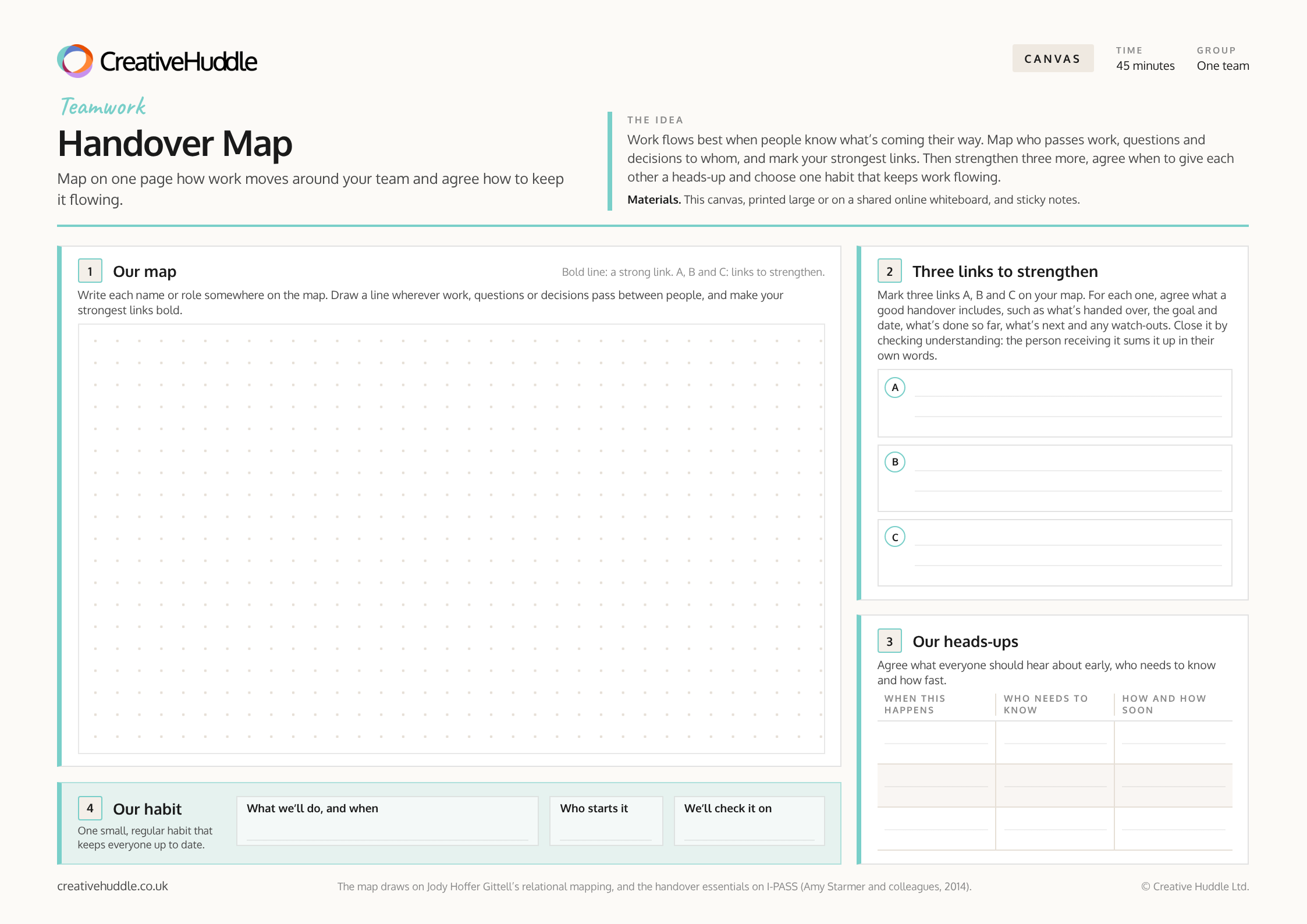
The Handover Map is a one-page map a team builds together about how its work moves. It has four boxes: our map, three links to strengthen, our heads-ups and our habit. It suits any team, whether its work moves side by side, one after another or back and forth.
Trusted by teams at


Work flows best when people know what's coming their way. The Handover Map helps a team see how its work really moves and agree how to keep it flowing.
Our map comes first. James Thompson described three ways people's work can depend on each other: side by side, one after another, and back and forth (Organizations in Action, 1967). Most teams use all three, so the map is freeform: names anywhere on the page and a line wherever work, questions or decisions pass. Jody Hoffer Gittell and her co-authors describe this kind of relational map as a way for a group to see the whole together (American Review of Public Administration, 2024).
The strongest links show what already works. Gittell's research on relational coordination names seven ingredients: shared goals, shared knowledge, mutual respect, and communication that's frequent, timely, accurate and focused on solving problems. A review of 233 studies in 73 industries and 36 countries by Rendelle Bolton and colleagues linked relational coordination with better quality, more learning and greater job satisfaction (Journal of Applied Behavioral Science, 2021).
Three links to strengthen puts that learning to work. For each link, the team agrees what a good handover includes, such as the goal and date, what's done so far, what's next and any watch-outs, and the person receiving it sums it up in their own words. These ideas draw on I-PASS, the structured handover studied by Amy Starmer and colleagues (New England Journal of Medicine, 2014). When 32 hospitals adopted I-PASS, the share of spoken handovers that covered all five of its essentials rose from 20% to 66% (Journal of Hospital Medicine, 2023).
Our heads-ups sets out what everyone should hear about early, who needs to know and how fast. A review of 72 studies covering 4,795 groups by Jessica Mesmer-Magnus and Leslie DeChurch found that teams that shared information performed better, and sharing what others didn't already know mattered most (Journal of Applied Psychology, 2009).
Our habit closes the map with one small, regular behaviour that keeps everyone up to date. Gerardo Okhuysen and Beth Bechky name predictability, knowing what's coming, as one of three conditions that coordination rests on (Academy of Management Annals, 2009).
Use the Handover Map when a team wants work to move smoothly between people, however that work flows. The team maps who passes work to whom, strengthens three links, agrees its heads-ups and sets one habit, all on a single page.
The team leaves with a completed Handover Map that shows who passes work, questions and decisions to whom, what a good handover includes on three links it wants to strengthen, what everyone should hear about early and one habit that keeps work flowing. Everyone knows what's coming their way.

Each step shows how long it takes, the questions or prompts to ask the team and what happens.
How does our work move between us?
Ask whether most of the team's work moves side by side, one after another or back and forth. Then write each name or role somewhere on the map and draw a line wherever work, questions or decisions pass often. Make the strongest links bold.
What makes our strongest links work?
Pick two or three bold links and ask the people on them what makes them work. Use the seven ingredients of relational coordination as prompts: shared goals, shared knowledge, mutual respect, and communication that's frequent, timely, accurate and focused on solving problems.
What does the next person need from us?
Ask the team to pick three links to strengthen and mark them A, B and C on the map. For each one, agree what a good handover includes, such as what's handed over, the goal and date, what's done so far, what's next and any watch-outs, and write it in the Three links to strengthen box. Then agree to close each handover by checking understanding, with the person receiving it summing it up in their own words.
What should we hear about early?
List the changes everyone should hear about early, such as a deadline moving, new work coming in or priorities changing. For each one, agree who needs to know and how fast, and write it in the Our heads-ups box.
What will we do to keep work flowing?
Offer a short list of habits that keep everyone up to date, such as a Monday round of what's coming your way, a short checklist for key handovers, a same-day heads-up when plans change or a shared view of upcoming work. The team ranks them and agrees one in its own words, including when it happens and who starts it, and writes it in the Our habit box with a check-in date 30 days on.
The Handover Map canvas, printed large or on a shared online whiteboard, and sticky notes
Before the session, ask each person to note who they pass work to and receive it from most often. Then work through the four boxes in order. Teams can map roles instead of names if they prefer.
Add this tool to your session, then build a timed agenda in the Toolkit.
Add to your session
The four-box map to fill in together, with a worked example on the second page.
Add it to your session and the Toolkit builds a timed agenda around it.
Old template parts, hidden. Safe to delete once the new layout is approved.
Map on one page how work moves around your team and agree how to keep it flowing.
The Handover Map is a one-page map a team builds together about how its work moves. It has four boxes: our map, three links to strengthen, our heads-ups and our habit. It suits any team, whether its work moves side by side, one after another or back and forth.


Using this tool with a skilled facilitator means that discussions are focused, time is used efficiently, and the group moves toward consensus, making the session productive and impactful.
The canvas is free to download and use however suits you. If you want the full facilitator's guide to run the exercise properly, that sits inside the kit.
Facilitator's guide
The canvas