Toolkit
|
Deliver

Team Promise Map

Map on one page who has promised what, for whom and by when.

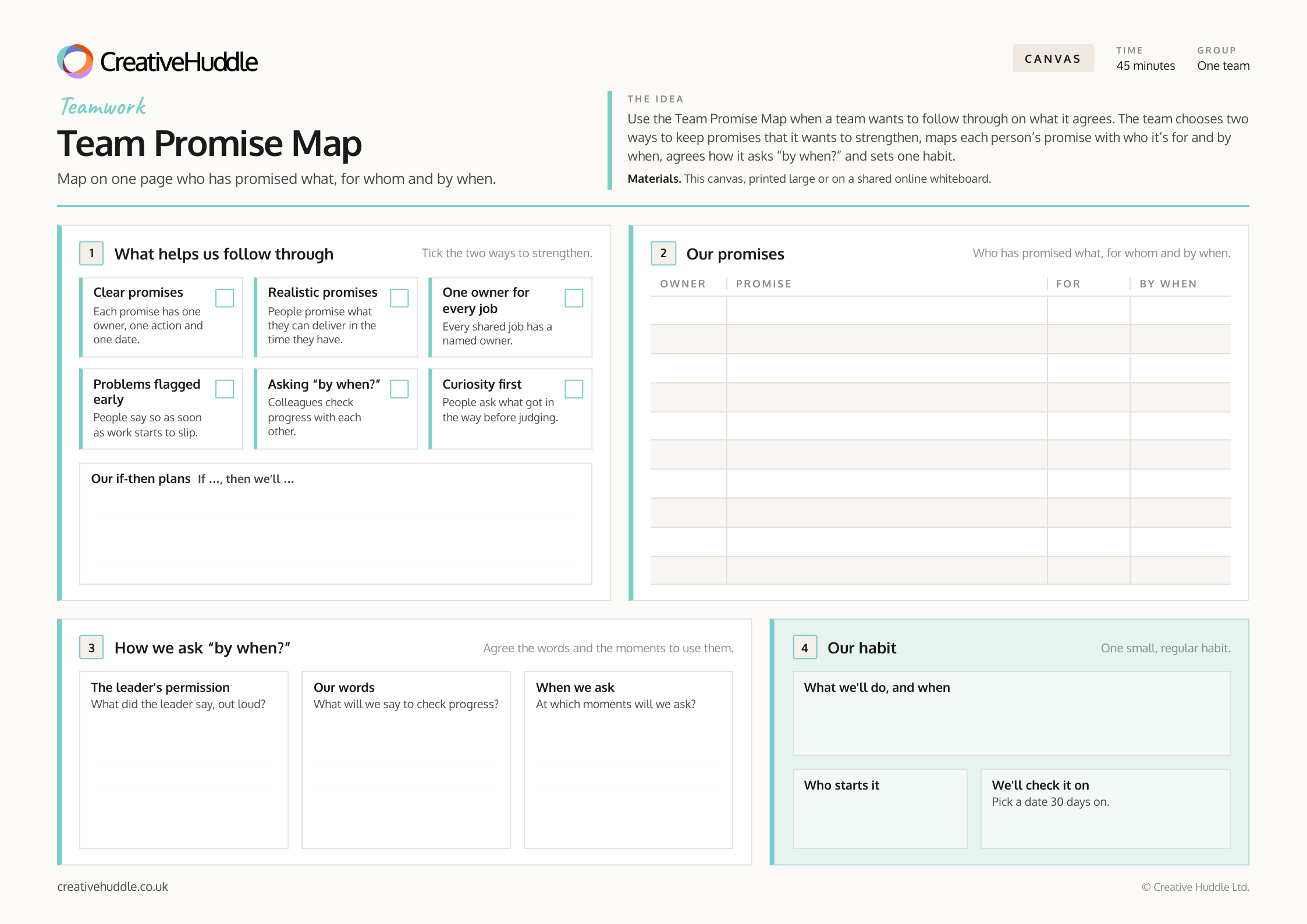
The Team Promise Map is a one-page map a team builds together about following through. It has four boxes: what helps us follow through, our promises, how we ask “by when?” and our habit. Each promise follows a simple rule: one owner, one action and one date, with a note of who it's for.

Type
Canvas
Time
45 minutes
Group size
One team
Best used as
Team commitment

Trusted by teams at

Why it works

Teams that keep their promises spend less time chasing and more time doing. The Team Promise Map helps a team agree what will help it follow through, then put that into practice.

What helps us follow through comes first. The team looks at six ways to keep promises, such as being realistic, giving every job one owner and flagging problems early. Flagging problems early depends on trust: Google's study of 180 teams found that what mattered most was people feeling safe to admit a mistake without being embarrassed or punished (Project Aristotle, 2015). The team votes for the two it most wants to strengthen and turns each into an if-then plan. A review of 642 tests by Peter Sheeran and colleagues found that if-then plans help people follow through (European Review of Social Psychology, 2025).

Our promises puts this to work. Each person writes one real promise on a promise postcard, with one owner, one action and one date, and notes who it's for. They also score how sure they are that they'll deliver on time, and adjust the promise or the date if the score is below 7. Carolyn Taylor describes accountability as a promise between two people, one who asks and one who gives, which works best when the request is clear (Accountability at Work, 2021).

How we ask “by when?” sets out how colleagues check progress with each other. Patrick Lencioni wrote that in strong teams, members are willing to call their peers on performance or behaviour that might hurt the team (The Five Dysfunctions of a Team, 2002), and the leader's permission makes that easier.

Our habit closes the map with one small, regular behaviour, such as reading back who promised what by when at the end of each meeting.

Use the Team Promise Map when a team wants to follow through on what it agrees. The team names what helps it follow through, maps who has promised what, for whom and by when, agrees how it asks “by when?” and sets one habit, all on a single page.

What the team leaves with

The team leaves with a completed Team Promise Map that names what helps it follow through, with an if-then plan for each, maps who has promised what, for whom and by when, sets out how people ask each other “by when?” and records one habit to keep promises visible. Everyone knows who owns what, and colleagues can hold each other to account.

Illustration of a woman with orange hair holding a tablet and giving a thumbs up.

It works best when

  • Actions from meetings slip from week to week.
  • Shared work has no clear owner.
  • The leader does most of the chasing.

For a different goal

How to run it

Each step shows how long it takes, the questions or prompts to ask the team and what happens.

1
Choose two to strengthen
10 minutes
Which two would help us follow through most?

The What helps us follow through box lists six ways to keep promises, such as realistic promises and flagging problems early. Ask the team to vote for the two it most wants to strengthen and tick them. Then turn each into an if-then plan, such as “if a deadline looks at risk, we'll say so that day”, and write it under Our if-then plans.

2
Map our promises
15 minutes
What have we promised, for whom and by when?

Give each person a promise postcard. On the message side, they write one promise they've made at work in the last month, who is waiting on it and what would help them keep it. On the address side, they write it as one clear action with a date, then score how sure they are that they'll deliver on time. Anyone who scores below 7 adjusts the promise or the date. Read a few aloud and test each one: could anyone tell when it's done? Add each promise to the Our promises box, with who it's for and by when.

3
Agree how we ask
10 minutes
What will we say to check progress, and when?

Ask the leader to give the team permission, out loud, to hold each other to account, and write what they said under The leader's permission. Pairs practise one short “by when?” conversation about a real piece of work. Write the team's agreed wording under Our words and the moments to use it under When we ask.

4
Agree one habit
10 minutes
Which habit will keep our promises visible?

Offer a short list of habits that would keep promises visible, such as reading back who promised what by when at the end of each meeting. The team ranks them and agrees one in its own words. Write it in the Our habit box with who starts it, and pick a date 30 days on to check it.

Materials

The Team Promise Map canvas, printed large or on a shared online whiteboard, and a promise postcard for each person

Before you start

Work through the four boxes in order: what helps us follow through, our promises, how we ask “by when?” and our habit. The leader opens with a commitment they let slip and what they changed afterwards, which makes it easier for everyone else to be honest.

Plan a session

Add this tool to your session, then build a timed agenda in the Toolkit.

Add to your session
Canvas preview

Print it, or use it on a whiteboard.

The four-box map to fill in together and a promise postcard for each person, with a worked example of both.

We'll email you the tool. You can unsubscribe from any email in one click. Read our privacy policy.

PDF · A4 · 4 pages

Download the PDF →

Run this tool with your team

Add it to your session and the Toolkit builds a timed agenda around it.

Old template parts, hidden. Safe to delete once the new layout is approved.

Team Promise Map

Map on one page who has promised what, for whom and by when.

The Team Promise Map is a one-page map a team builds together about following through. It has four boxes: what helps us follow through, our promises, how we ask “by when?” and our habit. Each promise follows a simple rule: one owner, one action and one date, with a note of who it's for.

Type
Canvas
Time
45 minutes
Group size
One team
Best as
Team commitment
In depth

A little more detail.

Three people discussing colorful sticky notes on a transparent board in a teamwork session.
Outcomes

What you'll leave with.

Illustration of two people with orange backpacks viewed from behind, looking sideways and smiling.
BRIEF Facilitation notes

How to run it.

When to use it

Use it when

Not the right tool when

Use it with your team

This tool works best in a well-facilitated room.

Using this tool with a skilled facilitator means that discussions are focused, time is used efficiently, and the group moves toward consensus, making the session productive and impactful.

Downloads

Take it away and use it.

The canvas is free to download and use however suits you. If you want the full facilitator's guide to run the exercise properly, that sits inside the kit.

Related tools

Facilitator's guide

The canvas

Part of the