Write on one page what keeps you steady and how you'll stay at your best.
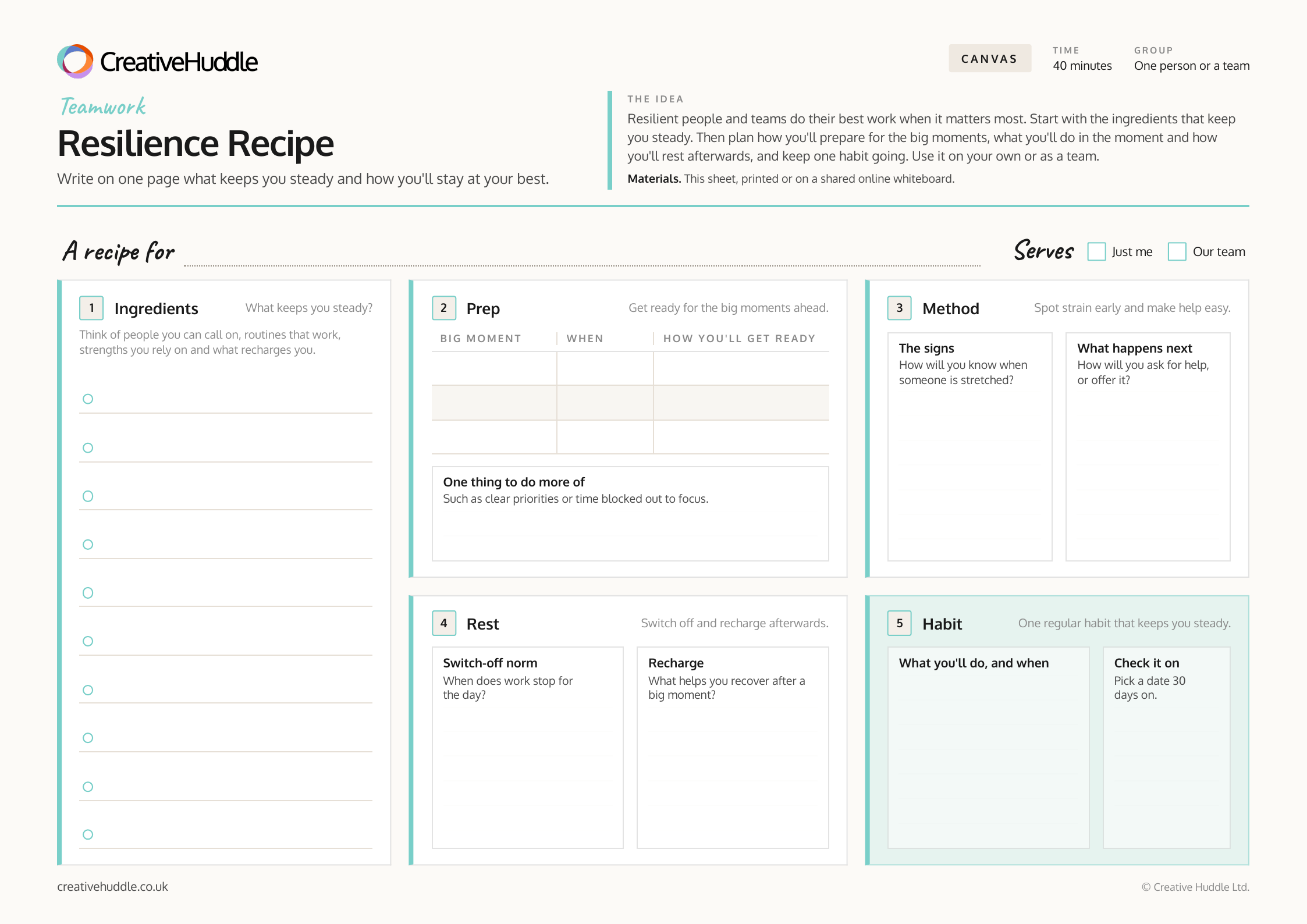
The Resilience Recipe is a one-page recipe for staying steady when the stakes are high, which people can write on their own or as a team. Its five parts are ingredients, prep, method, rest and habit. Prep, method and rest follow the three stages of resilience: minimise, manage and mend.
Trusted by teams at


Resilient teams do their best work when it matters most. George Alliger and colleagues describe three stages of team resilience: minimise, manage and mend (Organizational Dynamics, 2015). The Resilience Recipe covers all three, and you can use it on your own or as a team.
Ingredients come first. Arnold Bakker and colleagues show that resources such as support from colleagues, autonomy and feedback keep people engaged and performing well, and that they matter most when demands are high (Annual Review of Organizational Psychology and Organizational Behavior, 2023). Naming yours makes them easier to draw on.
Prep covers the minimise stage. You look at the next three months, name the big moments ahead, such as a launch or a key deadline, and pick one thing to prepare for each. You also agree one thing that will help you do your best work, such as setting clear priorities or blocking out time to focus.
Method covers the manage stage: the signs that someone is stretched and what happens next, including how to ask for help. Rest covers the mend stage. Sabine Sonnentag and Charlotte Fritz found that switching off from work, physically and mentally, restores energy (Journal of Occupational Health Psychology, 2007).
Habit closes the recipe with one regular behaviour, such as offering help before anyone has to ask. Xuan Zhao and Nicholas Epley found that people asking for help underestimate how willing others are to help and how good helping makes them feel (Psychological Science, 2022).
Use the Resilience Recipe when a person or a team wants to stay steady and do their best work through busy periods. On a single page, it names the ingredients that keep you going, plans for the big moments ahead, agrees how to spot strain and switch off, and sets one habit.
You leave with a completed Resilience Recipe: the ingredients that keep you steady, how you'll prepare for the big moments ahead, how you'll spot strain and ask for help, how you'll switch off and one habit to keep it going. When a team writes one together, everyone knows how they'll support each other when it matters most.

Each step shows how long it takes, the questions or prompts to ask the team and what happens.
What keeps you steady?
Write what the recipe is for along the top, such as staying steady through a launch, and tick whether it serves just you or your team. Then ask what keeps people steady and at their best, such as colleagues they can call on, routines that work, strengths they rely on and what recharges them outside work. Write them in the Ingredients box.
Which big moments are coming, and how will you get ready?
Look at the next three months and name the big moments ahead, such as a launch or a key deadline. For each one, write when it is and one thing to prepare in advance. Then agree one thing to do more of that will help you do your best work, such as setting clear priorities or blocking out time to focus. Write them in the Prep box.
How will you know when someone is stretched, and what happens next?
Ask how you would know when someone is stretched, and write the answers under The signs. Then agree what happens next, including how people ask for help or offer it, and write it under What happens next.
When does work stop, and what helps you recover?
Share Sonnentag's research on switching off and agree one switch-off norm, such as a time after which messages wait until morning. Then name what helps you recover after a big moment. Write them under Switch-off norm and Recharge in the Rest box.
Which habit will keep you steady?
Offer a short list of habits that keep people steady, such as offering help before anyone has to ask or a weekly round of who could use a hand. Rank them and agree one in your own words, including when it happens. Write it in the Habit box, and pick a date 30 days on to check it.
The Resilience Recipe sheet, printed or on a shared online whiteboard
Work through the recipe in order: ingredients, prep, method, rest, then the habit. If you're leading a team, open by sharing what resilience means to you and a time the team stepped up when it mattered. If you're using it on your own, keep the finished recipe where you'll see it each week.
Add this tool to your session, then build a timed agenda in the Toolkit.
Add to your session
The five-part recipe to write on your own or as a team, with a worked example on the second page.
Add it to your session and the Toolkit builds a timed agenda around it.
Old template parts, hidden. Safe to delete once the new layout is approved.
Write on one page what keeps you steady and how you'll stay at your best.
The Resilience Recipe is a one-page recipe for staying steady when the stakes are high, which people can write on their own or as a team. Its five parts are ingredients, prep, method, rest and habit. Prep, method and rest follow the three stages of resilience: minimise, manage and mend.


Using this tool with a skilled facilitator means that discussions are focused, time is used efficiently, and the group moves toward consensus, making the session productive and impactful.
The canvas is free to download and use however suits you. If you want the full facilitator's guide to run the exercise properly, that sits inside the kit.
Facilitator's guide
The canvas