Toolkit
|
Connect

Greatest Hits Chart

Put your team's wins on one page, pick your top three and agree how you'll keep noticing wins.

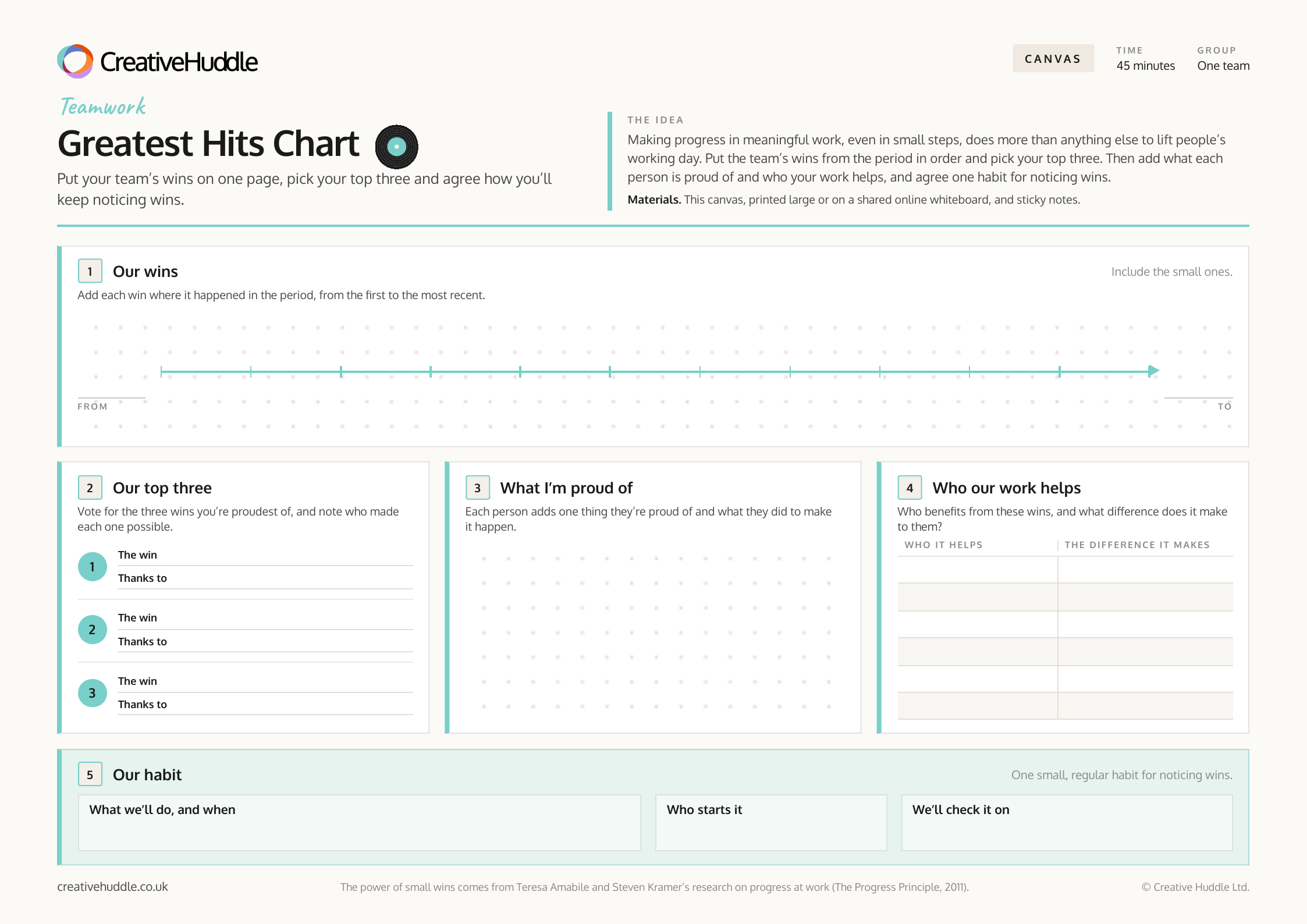
The Greatest Hits Chart is a one-page record a team builds together about what it has achieved. It has five boxes: our wins, our top three, what I'm proud of, who our work helps and our habit. The team fills it from a short piece of pre-work in which each person notes three team wins from the period.

Type
Canvas
Time
45 minutes
Group size
One team
Best used as
Team commitment

Trusted by teams at

Why it works

Teams that stop to notice their progress find more meaning in their work. The Greatest Hits Chart gives a team a structured way to look back together.

Our wins draws on Teresa Amabile and Steven Kramer's progress principle. They found that making progress in meaningful work, even in small steps, is the biggest driver of a good inner work life (The Progress Principle, 2011). The team puts its wins on a timeline, including small ones.

Our top three asks the team to vote for its best wins and tell the story behind each one, including who made it possible. Fred Bryant and Joseph Veroff showed that dwelling deliberately on good experiences extends their benefit (Savoring, 2007).

What I'm proud of turns to each person. Jessica Tracy and Richard Robins link authentic pride to the effort behind an achievement (Journal of Personality and Social Psychology, 2007), so each person notes what they're proud of and what they did to make it happen.

Who our work helps connects the wins to the people who benefit. In Adam Grant's study, university fundraisers who met a student their calls had funded raised 171% more money a month later (Organizational Behavior and Human Decision Processes, 2007). Our habit closes the chart with one small, regular behaviour, such as a weekly wins round.

Use the Greatest Hits Chart when a team wants to look back at what it has achieved and keep noticing its progress. The team maps its wins, picks its top three, shares what each person is proud of, names who its work helps and agrees one habit, all on a single page.

What the team leaves with

The team leaves with a completed Greatest Hits Chart that shows its wins over the period, its top three and who made them possible, what each person is proud of, the people its work helps and one habit for noticing wins. Everyone sees how far the team has come, and the leader has a clear record to share.

Illustration of a woman with orange hair holding a tablet and giving a thumbs up.

It works best when

  • The team has finished a big project or a busy year.
  • The team moves fast and wants to pause and look back.
  • The team wants a lift after a demanding period.

For a different goal

How to run it

Each step shows how long it takes, the questions or prompts to ask the team and what happens.

1
Map the wins
10 minutes
What have we achieved together?

Write the period at either end of the timeline. Ask each person to add the wins from their pre-work where they happened, including small ones. Group duplicates and read the timeline aloud from start to finish.

2
Pick the top three
10 minutes
Which wins are we proudest of?

Ask the team to vote for its top three. For each one, ask someone close to it to tell the story in a minute: what happened and who made it possible. Write each win and the people behind it in the Our top three box.

3
Share what you're proud of
8 minutes
What are you proud of, and what did you do to make it happen?

In pairs, each person tells their partner about something they're proud of, and the partner asks what they did to make it happen. Each person then adds a note to the What I'm proud of box.

4
Name who it helps
8 minutes
Who does our work help?

Share a real customer or user story, or invite someone close to the people the team serves to describe the difference its work makes. Ask the team who benefits from its wins and what difference they make, and fill in the Who our work helps box.

5
Agree one habit
9 minutes
What will we do to keep noticing our wins?

Offer a short list of habits for noticing wins, such as a weekly wins round. The team ranks them and agrees one in its own words. Write it in the Our habit box with who starts it and a date to check it. The leader closes with a specific thank-you.

Materials

The Greatest Hits Chart canvas, printed large or on a shared online whiteboard, and sticky notes

Before you start

Work through the five boxes in order. Before the session, ask each person to note three team wins from the period. The leader closes with a specific thank-you that names people's contributions.

Plan a session

Add this tool to your session, then build a timed agenda in the Toolkit.

Add to your session
Canvas preview

Print it, or use it on a whiteboard.

The five-box chart to fill in together, with a worked example on the second page.

We'll email you the tool. You can unsubscribe from any email in one click. Read our privacy policy.

PDF · A4 · 2 pages

Download the PDF →

Run this tool with your team

Add it to your session and the Toolkit builds a timed agenda around it.

Old template parts, hidden. Safe to delete once the new layout is approved.

Greatest Hits Chart

Put your team's wins on one page, pick your top three and agree how you'll keep noticing wins.

The Greatest Hits Chart is a one-page record a team builds together about what it has achieved. It has five boxes: our wins, our top three, what I'm proud of, who our work helps and our habit. The team fills it from a short piece of pre-work in which each person notes three team wins from the period.

Type
Canvas
Time
45 minutes
Group size
One team
Best as
Team commitment
In depth

A little more detail.

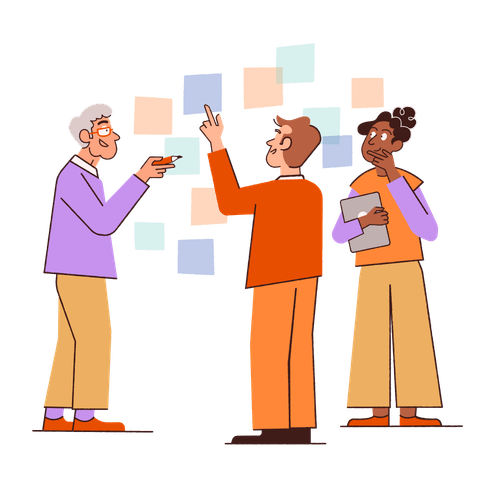
Three people discussing colorful sticky notes on a transparent board in a teamwork session.
Outcomes

What you'll leave with.

Illustration of two people with orange backpacks viewed from behind, looking sideways and smiling.
BRIEF Facilitation notes

How to run it.

When to use it

Use it when

Not the right tool when

Use it with your team

This tool works best in a well-facilitated room.

Using this tool with a skilled facilitator means that discussions are focused, time is used efficiently, and the group moves toward consensus, making the session productive and impactful.

Downloads

Take it away and use it.

The canvas is free to download and use however suits you. If you want the full facilitator's guide to run the exercise properly, that sits inside the kit.

Related tools

Facilitator's guide

The canvas

Part of the