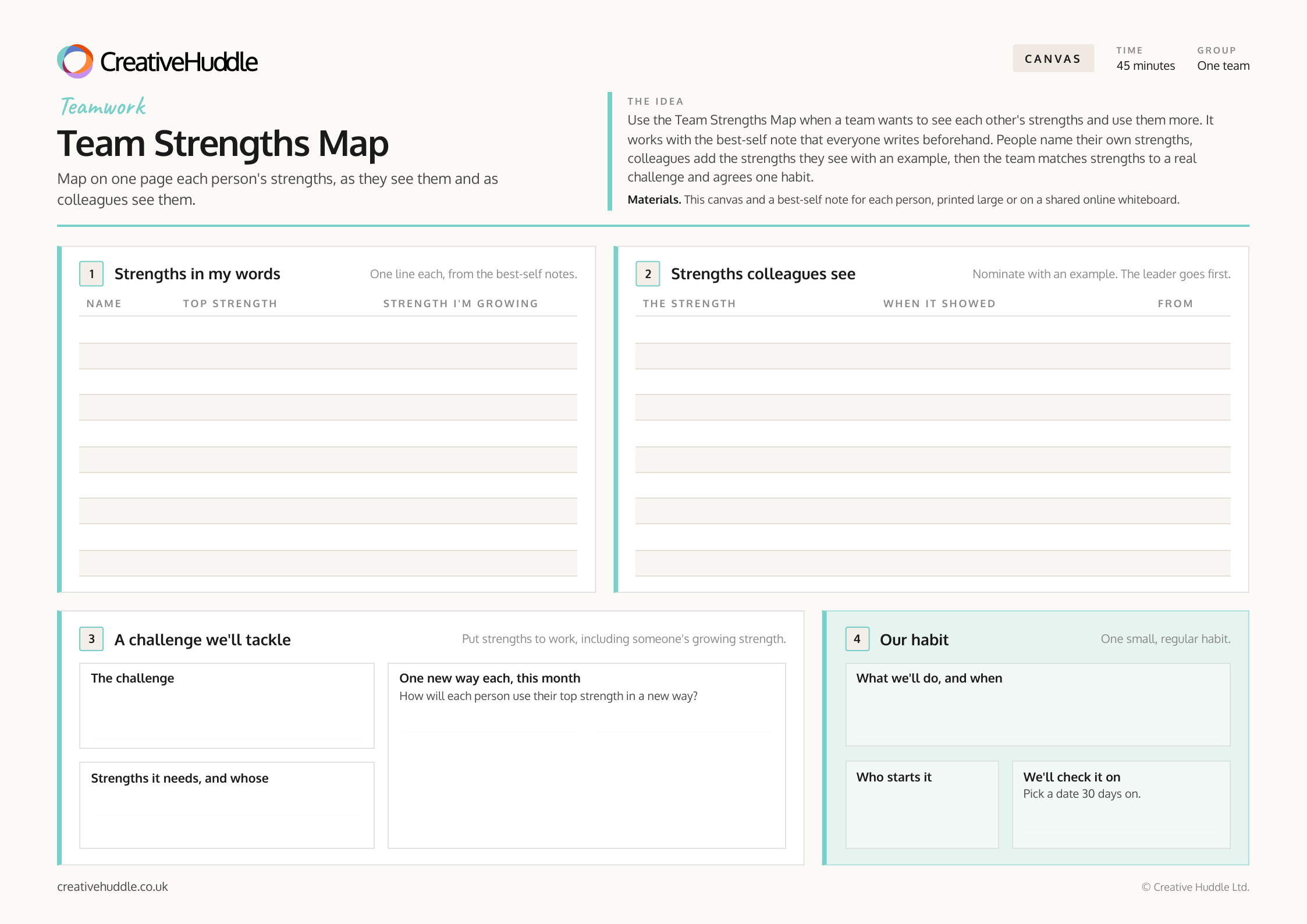
Map on one page each person's strengths, as they see them and as colleagues see them.
The Team Strengths Map is a one-page map a team builds together about its strengths. It has four boxes: strengths in my words, strengths colleagues see, a challenge we'll tackle and our habit. It works well with a short note that each person writes beforehand about a time they were at their best at work.
Trusted by teams at


Roy Baumeister and colleagues showed that negative information weighs more heavily than positive (Review of General Psychology, 2001), so teams tend to dwell on weaknesses. The Team Strengths Map gives strengths deliberate attention.
Strengths in my words comes first. Marcus Buckingham defines a strength as an activity that leaves you energised and keen to do more of it (Go Put Your Strengths to Work, 2007). Each person names their top strength and one they are growing, drawing on a time they were at their best at work.
Strengths colleagues see adds the view from outside. People find their own strengths hard to see, and modesty stops them naming them. Colleagues nominate each other's strengths with specific examples, and the leader goes first.
A challenge we'll tackle puts strengths to work on a real problem, often in a new way. Martin Seligman and colleagues found that people who used one of their top strengths in a new way every day for a week were happier for months afterwards (American Psychologist, 2005). Our habit closes the map with one small, regular behaviour, such as asking who's best placed before handing out a task.
Use the Team Strengths Map when a team wants to see each other's strengths and use them more. The team maps each person's strengths, matches them to a real challenge and agrees one habit, all on a single page.
The team leaves with a completed Team Strengths Map that shows each person's strengths in their own words and through colleagues' eyes, a real challenge matched to the strengths that suit it and one habit for using strengths every day. People see strengths in each other they hadn't noticed, and the leader can share out work with strengths in mind.

Each step shows how long it takes, the questions or prompts to ask the team and what happens.
What do you do well, and what strength are you growing?
Explain Marcus Buckingham's test: a strength leaves you energised. Ask each person to post their top strength and one strength they are growing, drawing on a time they were at their best at work. Write them in the Strengths in my words box, one line per person.
What strength have you seen in a colleague, and when?
Ask people to nominate a colleague's strength with a specific example of when they saw it. The leader goes first. Aim for every person to receive at least one nomination, and capture them in the Strengths colleagues see box.
Which strengths would help most with this challenge?
Pick a real challenge the team faces. Ask which strengths would help most, including someone's growing strength. Then ask each person to name one new way to use their strength this month. Write the challenge and the strengths it needs in the A challenge we'll tackle box.
What will we do to keep using our strengths?
Offer a short list of habits for using strengths in everyday work, such as asking who's best placed before handing out a task. The team ranks them and agrees one in its own words, including when it happens and who starts it, and writes it in the Our habit box with a check-in date 30 days on.
The Team Strengths Map canvas and a best-self note for each person, printed large or on a shared online whiteboard
Before the session, ask each person to fill in the best-self note on the second page, which takes 10 minutes. Then work through the four boxes in order: strengths in my words, strengths colleagues see, a challenge we'll tackle and our habit. The leader goes first in the second step by naming a colleague's strength with an example.
Add this tool to your session, then build a timed agenda in the Toolkit.
Add to your session
The four-box map to fill in together, with a best-self note to write beforehand and a worked example on the third page.
Add it to your session and the Toolkit builds a timed agenda around it.
Old template parts, hidden. Safe to delete once the new layout is approved.
Map on one page each person's strengths, as they see them and as colleagues see them.
The Team Strengths Map is a one-page map a team builds together about its strengths. It has four boxes: strengths in my words, strengths colleagues see, a challenge we'll tackle and our habit. It works well with a short note that each person writes beforehand about a time they were at their best at work.


Using this tool with a skilled facilitator means that discussions are focused, time is used efficiently, and the group moves toward consensus, making the session productive and impactful.
The canvas is free to download and use however suits you. If you want the full facilitator's guide to run the exercise properly, that sits inside the kit.
Facilitator's guide
The canvas