Agree on one page how your team builds trust and where you can lean on each other.
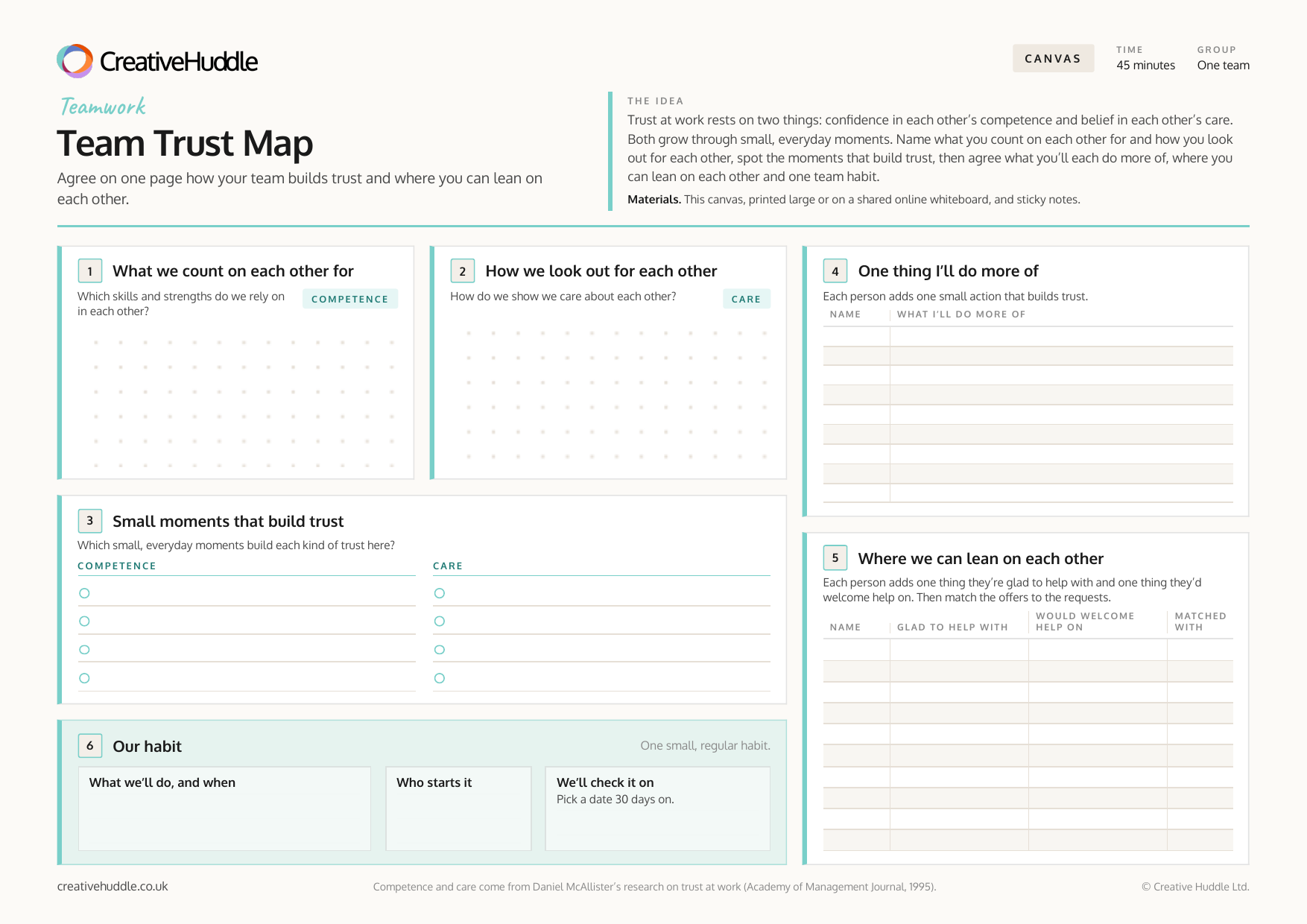
The Team Trust Map is a one-page record a team builds together about trust. It has six boxes: what we count on each other for, how we look out for each other, small moments that build trust, one thing I'll do more of, where we can lean on each other and our habit.
Trusted by teams at


Daniel McAllister found that trust at work rests on two things: confidence in a colleague's competence and belief in their care (Academy of Management Journal, 1995). The Team Trust Map runs those two kinds of trust through its first three boxes, so the team gives both attention.
What we count on each other for names the skills and strengths people rely on in each other. How we look out for each other names the ways people show they care. Small moments that build trust sorts the everyday actions that grow each kind, such as doing what you said on time or thanking people by name.
One thing I'll do more of turns the discussion into action, with one small step for each person. Where we can lean on each other makes help easy to ask for and give. Each person adds one thing they're glad to help with and one thing they'd welcome help on, and the team matches offers to requests. Xuan Zhao and Nicholas Epley found that people underestimate how glad colleagues are to help (Psychological Science, 2022), so naming offers in advance makes asking easier.
Our habit closes the map with one small, regular behaviour that keeps trust growing, such as a help round at the start of each team meeting.
Use the Team Trust Map when a team wants to talk about trust in a practical way and agree how to build more of it. The team names both kinds of trust, the moments that build them, what each person will do more of, where people can lean on each other and one habit, all on a single page.
The team leaves with a completed Team Trust Map that names what people count on each other for, how they look out for each other, the small moments that build trust, one action for each person and one team habit. Every request for help is matched with an offer, so people leave with help arranged.

Each step shows how long it takes, the questions or prompts to ask the team and what happens.
What makes a colleague easy to trust?
Ask everyone to post the traits of a colleague they find easy to trust. Sort them live into competence and care, and agree the ones that matter most. Write the competence traits in What we count on each other for and the care traits in How we look out for each other.
Which small, everyday moments build trust here?
Collect answers in a poll or on sticky notes, and sort them into the two columns of the Small moments box.
What's one small thing you'll do more of?
Ask each person to add their name and one action to the One thing I'll do more of box.
Where can we lean on each other?
Ask each person to add the offer and request they noted before the session. Match each request with an offer and write the name in the Matched with column.
Which of these will we still be doing in a month's time?
Offer a short list of habits that keep trust growing, such as a help round at the start of team meetings or a credit round at the end. The team ranks them and agrees one in its own words, including when it happens and who starts it, and writes it in the Our habit box.
The Team Trust Map canvas, printed large or on a shared online whiteboard, and sticky notes
Before the session, ask each person to note one thing they're glad to help with and one thing they'd welcome help on, ready for box 5.
Add this tool to your session, then build a timed agenda in the Toolkit.
Add to your session
The six-box map to fill in together, with a worked example on the second page.
Add it to your session and the Toolkit builds a timed agenda around it.
Old template parts, hidden. Safe to delete once the new layout is approved.
Agree on one page how your team builds trust and where you can lean on each other.
The Team Trust Map is a one-page record a team builds together about trust. It has six boxes: what we count on each other for, how we look out for each other, small moments that build trust, one thing I'll do more of, where we can lean on each other and our habit.


Using this tool with a skilled facilitator means that discussions are focused, time is used efficiently, and the group moves toward consensus, making the session productive and impactful.
The canvas is free to download and use however suits you. If you want the full facilitator's guide to run the exercise properly, that sits inside the kit.
Facilitator's guide
The canvas