Agree on one page how your team will speak up freely and keep the bar high.
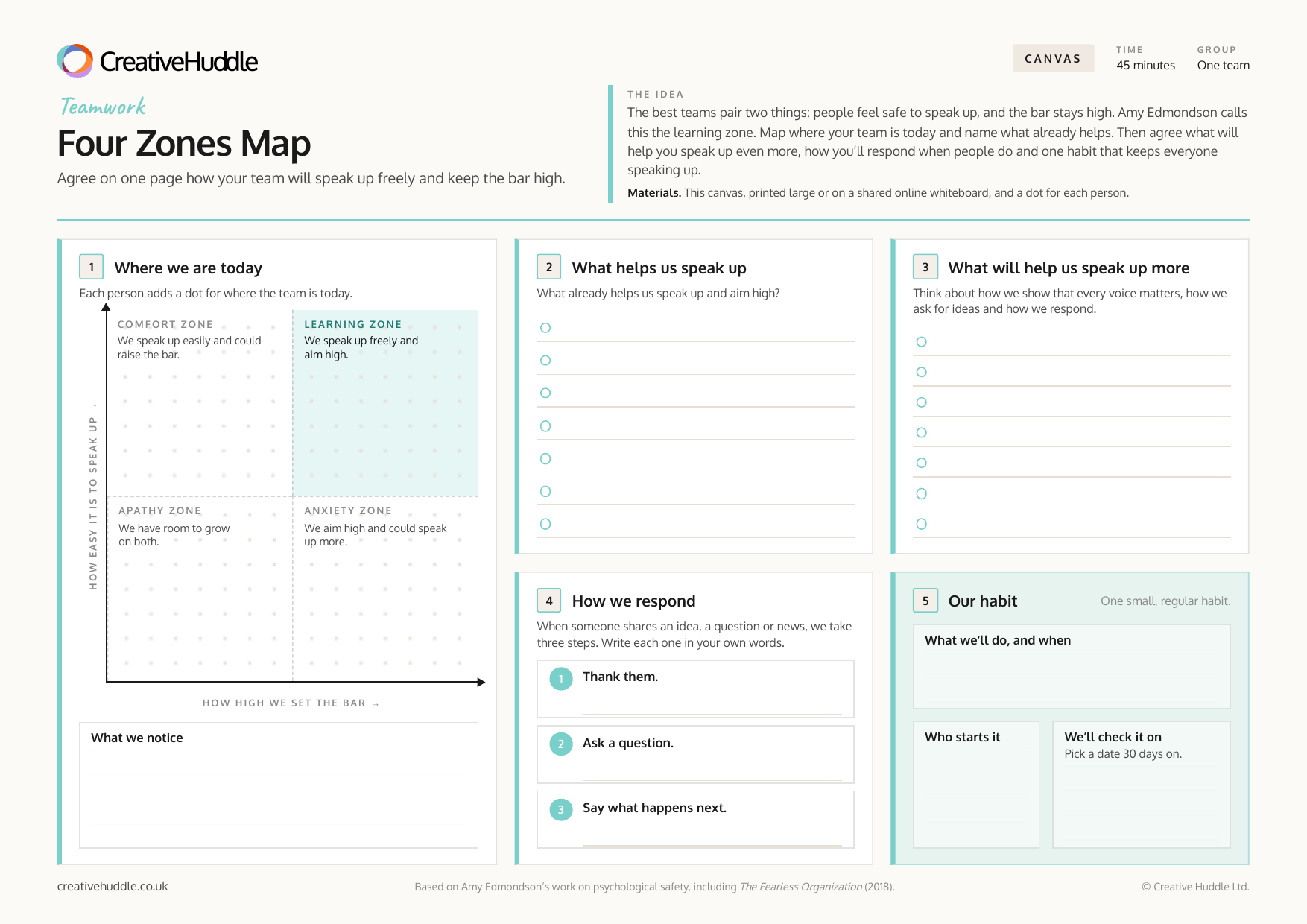
The Four Zones Map is a one-page record a team builds together about speaking up. It has five boxes: where we are today, what helps us speak up, what will help us speak up more, how we respond and our habit. It draws on Amy Edmondson's work on psychological safety and performance standards.
Trusted by teams at


The best teams pair two things: people feel safe to speak up, and the bar stays high. The Four Zones Map helps a team see where it is today and agree how to keep everyone speaking up.
Where we are today uses Amy Edmondson's grid (The Fearless Organization, 2018). One axis is psychological safety and the other is the standards the team holds. Together they give four zones, and the learning zone, where both are high, is where teams learn and perform best. Each person adds a dot for where the team is today, and the spread of dots starts the conversation.
What helps us speak up names what the team already does well. What will help us speak up more draws on Edmondson's three ways to help people speak up: set the stage by showing why every voice matters, invite participation by asking for ideas, and respond productively.
How we respond focuses on the moment someone speaks up. The team agrees three steps: thank them, ask a question and say what happens next. It writes each one in its own words. James Detert and Ethan Burris found that openness to ideas was the leader behaviour most consistently linked to employees speaking up (Academy of Management Journal, 2007). Our habit closes the map with one small, regular behaviour, such as asking for one build and one challenge before each decision.
Use the Four Zones Map when a team wants everyone to share ideas, questions and news freely while keeping the bar high. The team names where it is today, what helps, what will help more, how it will respond and one habit, all on a single page.
The team leaves with a completed Four Zones Map that shows where it is today on safety and standards, what already helps it speak up, what will help it speak up even more, how it will respond when people speak up and one habit that keeps everyone speaking up. Everyone sees the same picture, and the leader knows what to model.

Each step shows how long it takes, the questions or prompts to ask the team and what happens.
Where is our team on the grid today?
Explain Edmondson's grid of psychological safety and performance standards, and the learning zone where both are high. Ask each person to add a dot for where the team is today, using an anonymous poll or dots on the canvas. Share the spread without naming anyone and note what the team notices in the Where we are today box.
What already helps us speak up and aim high?
Collect examples, such as a leader who asks for ideas or a regular slot for questions. Write the ones the team agrees in the What helps us speak up box.
What would help us speak up even more?
Introduce Edmondson's three ways to help people speak up: set the stage, invite participation and respond productively. Ask for ideas under each, and write the ones the team agrees in the What will help us speak up more box.
When someone speaks up, how will we respond?
Practise responding in pairs with three steps: thank them, ask a question and say what happens next. Agree the team's own words for each step and write them in the How we respond box. Ask the leader to say how they'll respond when people speak up.
Which habit will keep everyone speaking up?
Offer a short list of habits that keep everyone speaking up, such as asking for one build and one challenge before each decision. The team ranks them and agrees one in its own words, including when it happens and who starts it, and writes it in the Our habit box.
The Four Zones Map canvas, printed or on a shared online whiteboard, and a dot for each person
Work through the five boxes in order. The leader opens by sharing a time someone's question or challenge made one of their ideas better, which shows the team that ideas and challenge are welcome.
Add this tool to your session, then build a timed agenda in the Toolkit.
Add to your session
The five-box map to fill in together, with a worked example on the second page.
Add it to your session and the Toolkit builds a timed agenda around it.
Old template parts, hidden. Safe to delete once the new layout is approved.
Agree on one page how your team will speak up freely and keep the bar high.
The Four Zones Map is a one-page record a team builds together about speaking up. It has five boxes: where we are today, what helps us speak up, what will help us speak up more, how we respond and our habit. It draws on Amy Edmondson's work on psychological safety and performance standards.


Using this tool with a skilled facilitator means that discussions are focused, time is used efficiently, and the group moves toward consensus, making the session productive and impactful.
The canvas is free to download and use however suits you. If you want the full facilitator's guide to run the exercise properly, that sits inside the kit.
Facilitator's guide
The canvas