Toolkit
|
Connect

Say It Card

Work out one piece of feedback for a colleague, from the type to the next step.

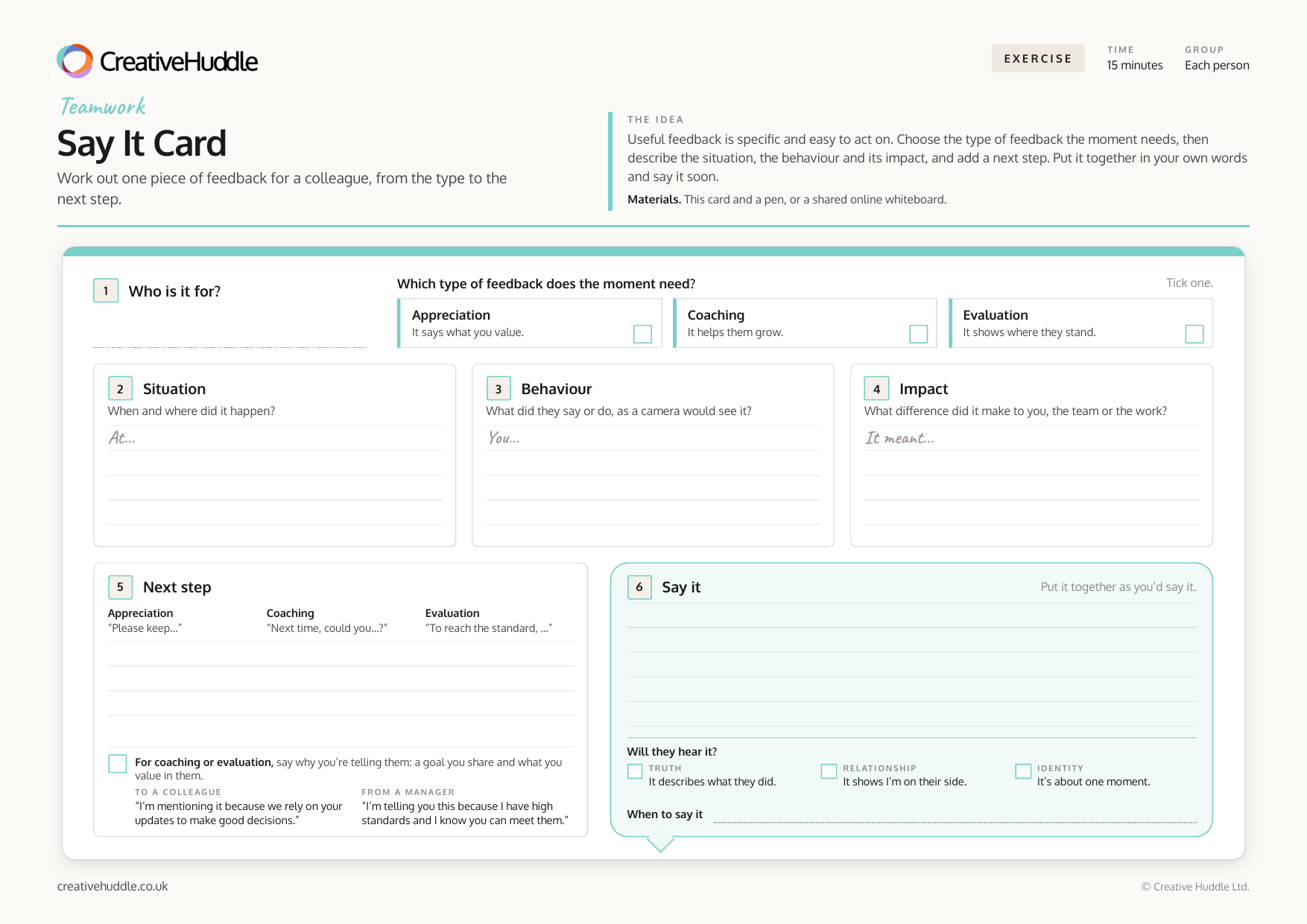
The Say It Card is a one-page card for working out one piece of feedback before you give it. You choose the type of feedback, describe the situation, the behaviour and its impact, and add a next step. Anyone can use it, on their own or in a team session.

Type
Exercise
Time
15 minutes
Group size
Each person
Best used as
Skills practice

Trusted by teams at

Why it works

Good feedback helps people see what to repeat and what to try next. Jack Zenger and Joseph Folkman found that 57% of people preferred corrective feedback to praise (Harvard Business Review, 2014). The Say It Card helps you give feedback that is specific and easy to use.

Start with the type. Douglas Stone and Sheila Heen describe three types of feedback: appreciation, coaching and evaluation (Thanks for the Feedback, 2014). Appreciation tells someone what you value, coaching helps them grow and evaluation shows where they stand. Choosing one keeps your message clear.

Then describe what happened with situation, behaviour and impact, a model from the Center for Creative Leadership. The situation says when and where, the behaviour says what the person did and the impact says what difference it made.

Finish with a next step. For coaching or evaluation, David Yeager and colleagues found that one extra sentence helps: a note about high standards and belief in the person led more students to act on feedback (Journal of Experimental Psychology: General, 2014). Their study looked at teachers and students. Between colleagues, the same idea works best as a goal you share and what you value in them.

Use the Say It Card when you want to give a colleague feedback that lands. It takes you from the type of feedback to a clear next step, all on a single card.

What the team leaves with

You leave with one piece of feedback ready to give: the right type for the moment, a clear account of what happened and why it mattered, and a next step the other person can act on. When a team uses the card together, everyone shares the same simple way to give feedback.

Illustration of a woman with orange hair holding a tablet and giving a thumbs up.

It works best when

  • A colleague has done something you want them to keep doing.
  • You have a suggestion that would help someone grow.
  • A team wants a shared, simple way to give feedback.

For a different goal

How to run it

Each step shows how long it takes, the questions or prompts to ask the team and what happens.

1
Choose the kind
2 minutes
Who is this feedback for, and what kind is it?

Write the person's name and tick the kind: appreciation to say what you value, coaching to help them grow, or evaluation to show where they stand.

2
Describe what happened
5 minutes
What did you see, and what difference did it make?

Describe the situation: when and where it happened. Then the behaviour: what the person said or did, as a camera would see it. Then the impact: what difference it made to you, the team or the work.

3
Add a next step
3 minutes
What would you like them to keep doing or try next?

For appreciation, say what you'd like them to keep doing. For coaching or evaluation, suggest one thing to try and say why you're telling them: a goal you share and what you value in them. To a colleague, that might be: “I'm mentioning it because we rely on your updates to make good decisions.” From a manager: “I'm telling you this because I have high standards and I know you can meet them.”

4
Check and say it
5 minutes
How will this sound when they hear it?

Put it together as you'd say it. Check it'll be heard: it describes what they did, it shows you're on their side and it's about one moment. These checks match Stone and Heen's three triggers: truth, relationship and identity. Then choose when to say it.

Materials

The Say It Card, printed or on a shared online whiteboard

Before you start

Use the card whenever you have feedback to give. In a team session, run a short practice first: the leader asks for one thing to keep and one thing to try, and people answer anonymously using situation, behaviour and impact. Then each person fills in a card for a colleague.

Plan a session

Add this tool to your session, then build a timed agenda in the Toolkit.

Add to your session
Canvas preview

Print it, or use it on a whiteboard.

The card each person fills in, with two worked examples.

We'll email you the tool. You can unsubscribe from any email in one click. Read our privacy policy.

PDF · A4 · 3 pages

Download the PDF →

Run this tool with your team

Add it to your session and the Toolkit builds a timed agenda around it.

Old template parts, hidden. Safe to delete once the new layout is approved.

Say It Card

Work out one piece of feedback for a colleague, from the type to the next step.

The Say It Card is a one-page card for working out one piece of feedback before you give it. You choose the type of feedback, describe the situation, the behaviour and its impact, and add a next step. Anyone can use it, on their own or in a team session.

Type
Exercise
Time
15 minutes
Group size
Each person
Best as
Skills practice
In depth

A little more detail.

Three people discussing colorful sticky notes on a transparent board in a teamwork session.
Outcomes

What you'll leave with.

Illustration of two people with orange backpacks viewed from behind, looking sideways and smiling.
BRIEF Facilitation notes

How to run it.

When to use it

Use it when

Not the right tool when

Use it with your team

This tool works best in a well-facilitated room.

Using this tool with a skilled facilitator means that discussions are focused, time is used efficiently, and the group moves toward consensus, making the session productive and impactful.

Downloads

Take it away and use it.

The canvas is free to download and use however suits you. If you want the full facilitator's guide to run the exercise properly, that sits inside the kit.

Related tools

Facilitator's guide

The canvas

Part of the