Toolkit
|
Align

Change Charter

Agree on one page how your team will make a change work.

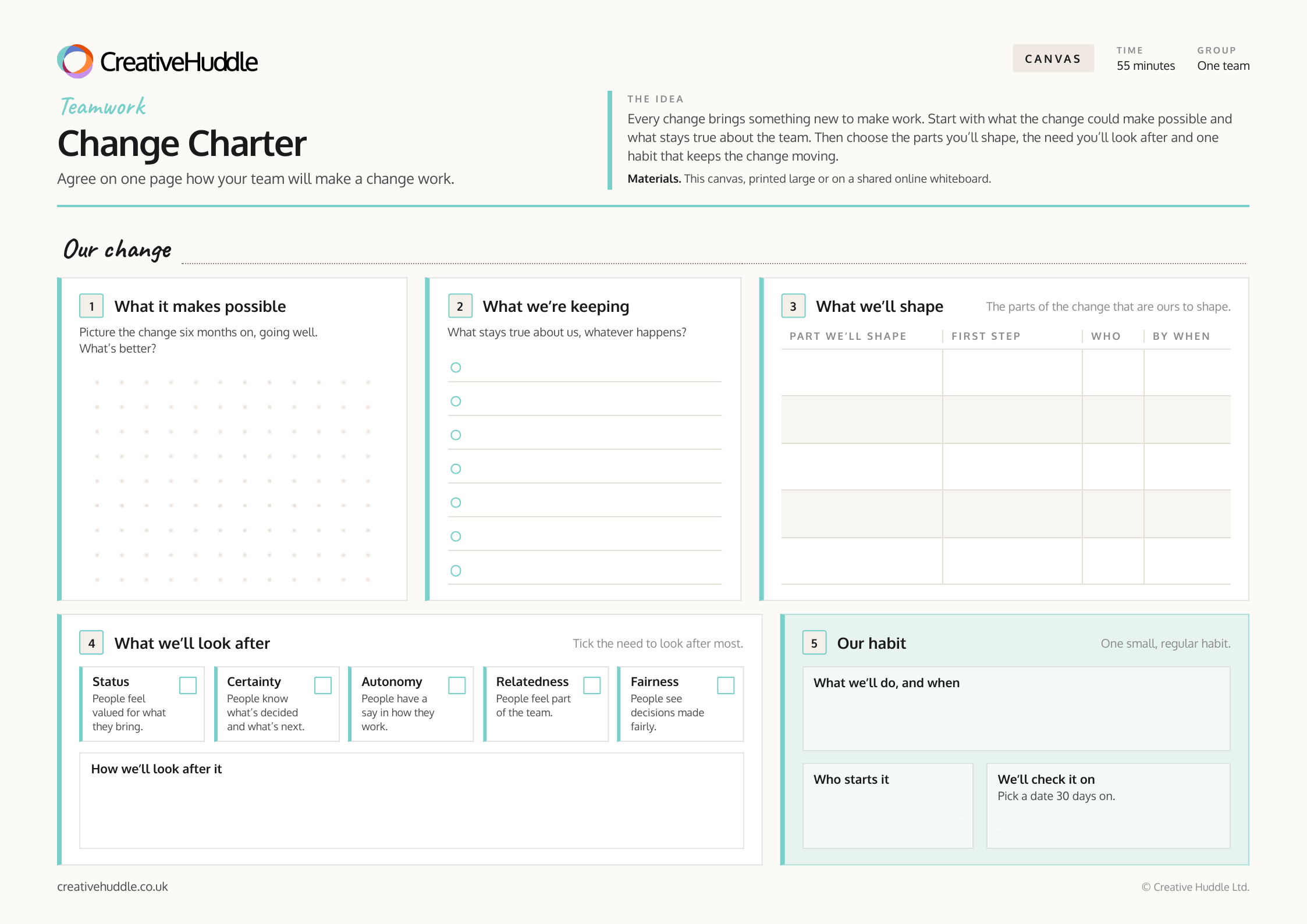
The Change Charter is a one-page agreement a team writes together about a change it shares. It has five boxes: what it makes possible, what we're keeping, what we'll shape, what we'll look after and our habit. The team fills each box in its own words.

Type
Canvas
Time
55 minutes
Group size
One team
Best used as
Team commitment

Trusted by teams at

Why it works

A change plan describes where an organisation is going. The Change Charter describes how one team will make the change work, starting from what the change could make possible.

What it makes possible comes first. The team pictures the change six months on, going well, and names what's better. Starting from the opportunity gives everyone a reason to make the change work.

What we're keeping gives the team its footing. Merlijn Venus, Daan Stam and Daan van Knippenberg found that people back a change more strongly when their leader describes what will stay the same as well as what will change (Academy of Management Journal, 2019).

What we'll shape gives the team a say. Connie Wanberg and Joseph Banas found that people were more open to a change when they had information about it, a chance to take part and confidence they could handle it (Journal of Applied Psychology, 2000). The team picks the parts of the change it can shape and a first step for each.

What we'll look after draws on David Rock's SCARF model: status, certainty, autonomy, relatedness and fairness (NeuroLeadership Journal, 2008). The team chooses the need it most wants to look after during the change. Our habit closes the charter with one small, regular behaviour that keeps the change moving.

Use the Change Charter when a team shares a change and wants to agree how it will make it work. The team names what the change makes possible, what it's keeping, what it will shape, what it will look after and one habit, all on a single page.

What the team leaves with

The team leaves with a completed Change Charter that names what the change makes possible, what stays true about the team, the parts of the change it will shape, the need it will look after and one habit to keep the change moving. Everyone sees the same picture of the change, and the leader has a clear record of the team's ideas and questions.

Illustration of a woman with orange hair holding a tablet and giving a thumbs up.

It works best when

  • A change has just been announced and the team wants a confident start.
  • The team wants a say in how a change works in practice.
  • A change is under way and the team wants to settle into the new way of working.

For a different goal

How to run it

Each step shows how long it takes, the questions or prompts to ask the team and what happens.

1
Picture what's possible
10 minutes
Six months on, with the change going well, what's better?

Write the change in a few words next to Our change at the top. Ask each person to picture the change six months on, going well, and to note one thing that's better. Collect the answers on sticky notes or in the chat, group similar ones and agree the three or four the team most wants. Write them in the What it makes possible box.

2
Name what we're keeping
10 minutes
What stays true about us, whatever happens?

Ask what stays true about this team whatever happens: its purpose, the people it serves, how its members treat each other and the standards it holds. Agree the three or four that matter most and write them in the What we're keeping box.

3
Choose what we'll shape
15 minutes
Which parts of the change are ours to shape?

List the parts of the change that are still open. Ask the team which it can shape, and agree a first step, who will take it and by when. Write them in the What we'll shape table.

4
Look after one need
10 minutes
Which need will we look after most?

Explain the five needs: status, certainty, autonomy, relatedness and fairness. Ask the team which one it most wants to look after during the change and tick it. Then agree how the team will look after it and write it under How we'll look after it.

5
Agree one habit
10 minutes
Which habit will keep the change moving?

Offer a short list of habits that would keep the change moving, such as a two-minute check-in on the change at the start of each team meeting. The team ranks them and agrees one in its own words. Write it in the Our habit box with who starts it, and pick a date 30 days on to check it.

Materials

The Change Charter canvas, printed large or on a shared online whiteboard

Before you start

Work through the five boxes in order. Before you start, say plainly what is decided and what the team can still shape, and invite questions throughout. Capture the team's own words in each box.

Plan a session

Add this tool to your session, then build a timed agenda in the Toolkit.

Add to your session
Canvas preview

Print it, or use it on a whiteboard.

The five-box charter to fill in together, with a worked example on the second page.

We'll email you the tool. You can unsubscribe from any email in one click. Read our privacy policy.

PDF · A4 · 2 pages

Download the PDF →

Run this tool with your team

Add it to your session and the Toolkit builds a timed agenda around it.

Old template parts, hidden. Safe to delete once the new layout is approved.

Change Charter

Agree on one page how your team will make a change work.

The Change Charter is a one-page agreement a team writes together about a change it shares. It has five boxes: what it makes possible, what we're keeping, what we'll shape, what we'll look after and our habit. The team fills each box in its own words.

Type
Canvas
Time
55 minutes
Group size
One team
Best as
Team commitment
In depth

A little more detail.

Three people discussing colorful sticky notes on a transparent board in a teamwork session.
Outcomes

What you'll leave with.

Illustration of two people with orange backpacks viewed from behind, looking sideways and smiling.
BRIEF Facilitation notes

How to run it.

When to use it

Use it when

Not the right tool when

Use it with your team

This tool works best in a well-facilitated room.

Using this tool with a skilled facilitator means that discussions are focused, time is used efficiently, and the group moves toward consensus, making the session productive and impactful.

Downloads

Take it away and use it.

The canvas is free to download and use however suits you. If you want the full facilitator's guide to run the exercise properly, that sits inside the kit.

Related tools

Facilitator's guide

The canvas

Part of the