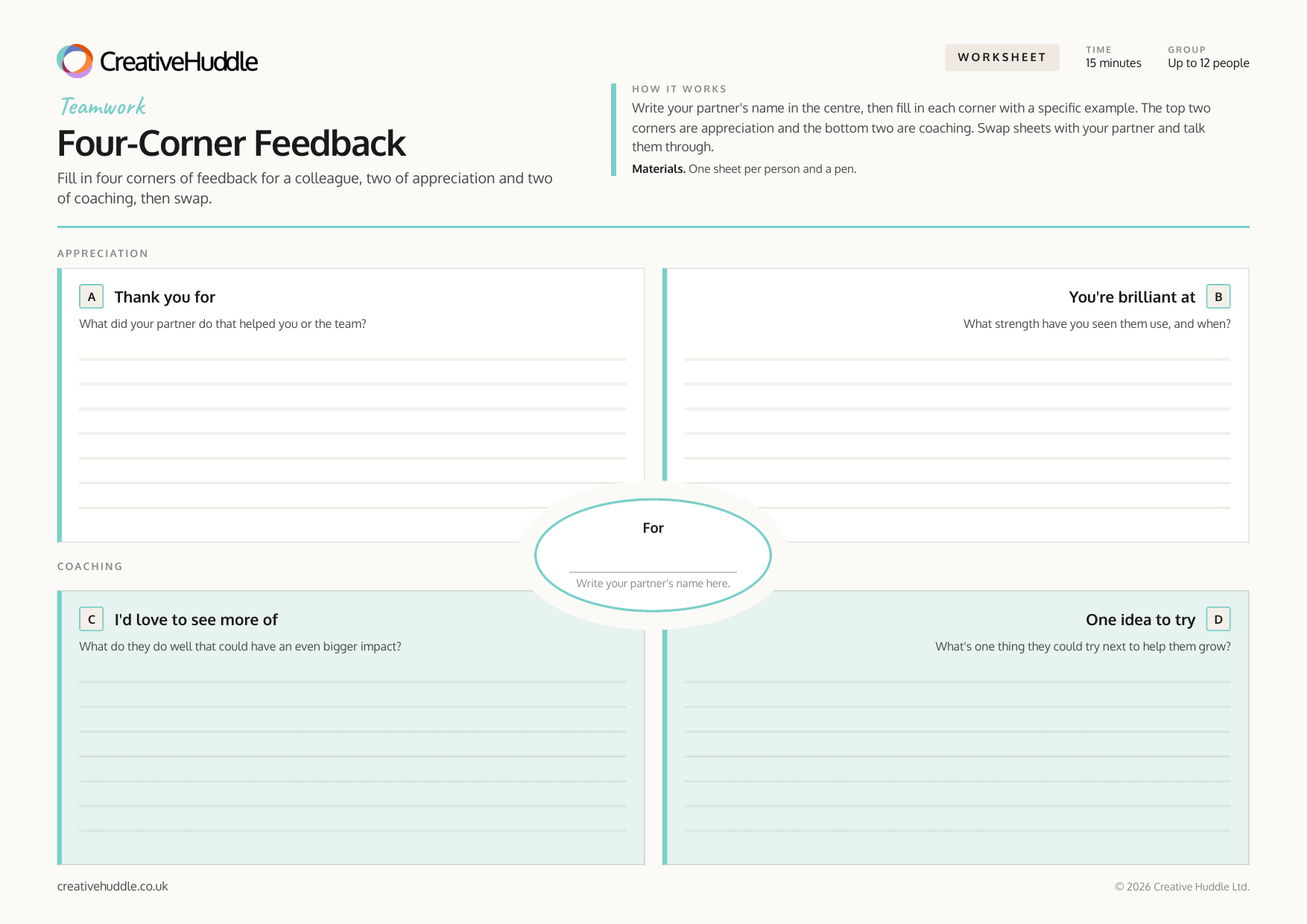
Fill in four corners of feedback for a colleague, two of appreciation and two of coaching, then swap.
Four-Corner Feedback is a one-page sheet each person fills in for a colleague, with two corners of appreciation and two of coaching. Partners swap sheets and talk them through, each person thanks their partner in front of the team, and everyone picks one idea to try.
Trusted by teams at


Douglas Stone and Sheila Heen describe three kinds of feedback, each with its own job (Thanks for the Feedback, 2014). In their account, appreciation shows people they're seen and valued, coaching helps someone learn and grow, and evaluation tells people where they stand.
Four-Corner Feedback uses the first two. The top corners name something the colleague did and a strength they show. The bottom corners build on those strengths with something to do more of and one idea to try, which keeps the coaching specific and forward-looking.
Kim Scott advises giving praise in public and criticism in private, and making praise specific (Radical Candor, 2017). The steps follow the same pattern: each person reads their thank you to the whole team, and the coaching corners stay between the pair.
Use Four-Corner Feedback to close an away day, a project or a quarter with feedback that helps people grow. Every person gets thanks and ideas from a colleague in 15 minutes, and the whole team hears the thanks.
Every person leaves with a sheet of appreciation and coaching from a colleague, with a specific example in each corner. Each person has chosen one idea to try, and the whole team has heard every thank you.

Each step shows how long it takes, the questions or prompts to ask the team and what happens.
What do you appreciate about your partner, and what could help them grow?
Each person writes their partner's name in the centre of the sheet and fills in the four corners, two of appreciation and two of coaching. Ask for one specific example in each corner, such as a meeting or a piece of work.
What would you like to ask about the feedback on your sheet?
Partners swap sheets and read them. Each person asks one question about their sheet, such as “what would that look like next week?”, and thanks their partner for the feedback.
What would you like to thank your partner for?
Go round the team. Each person reads out the thank you they wrote for their partner, in a sentence, so the whole team hears it. Online, people post their thanks in the chat. The coaching corners stay between each pair.
Which idea from your sheet will you try first?
Each person picks one idea from the coaching corners on their sheet and tells their partner when they'll try it. Everyone keeps their sheet.
The Four-Corner Feedback sheet, one per person, printed or shared as an online document, and pens
Print a Four-Corner Feedback sheet for each person, or send it as a document people can fill in online. Pair people who've worked closely together, and if the numbers are odd, make one group of three in which each person writes for the next person round. Online, put each pair in its own online breakout group for the second step.
Add this tool to your session, then build a timed agenda in the Toolkit.
Add to your session
One page with four corners, two for appreciation and two for coaching, and a space in the centre for your partner's name.
Add it to your session and the Toolkit builds a timed agenda around it.
Old template parts, hidden. Safe to delete once the new layout is approved.
Fill in four corners of feedback for a colleague, two of appreciation and two of coaching, then swap.
Four-Corner Feedback is a one-page sheet each person fills in for a colleague, with two corners of appreciation and two of coaching. Partners swap sheets and talk them through, each person thanks their partner in front of the team, and everyone picks one idea to try.


Using this tool with a skilled facilitator means that discussions are focused, time is used efficiently, and the group moves toward consensus, making the session productive and impactful.
The canvas is free to download and use however suits you. If you want the full facilitator's guide to run the exercise properly, that sits inside the kit.
Facilitator's guide
The canvas