Capture on one page a team's challenge, its ideas and the two it will act on.
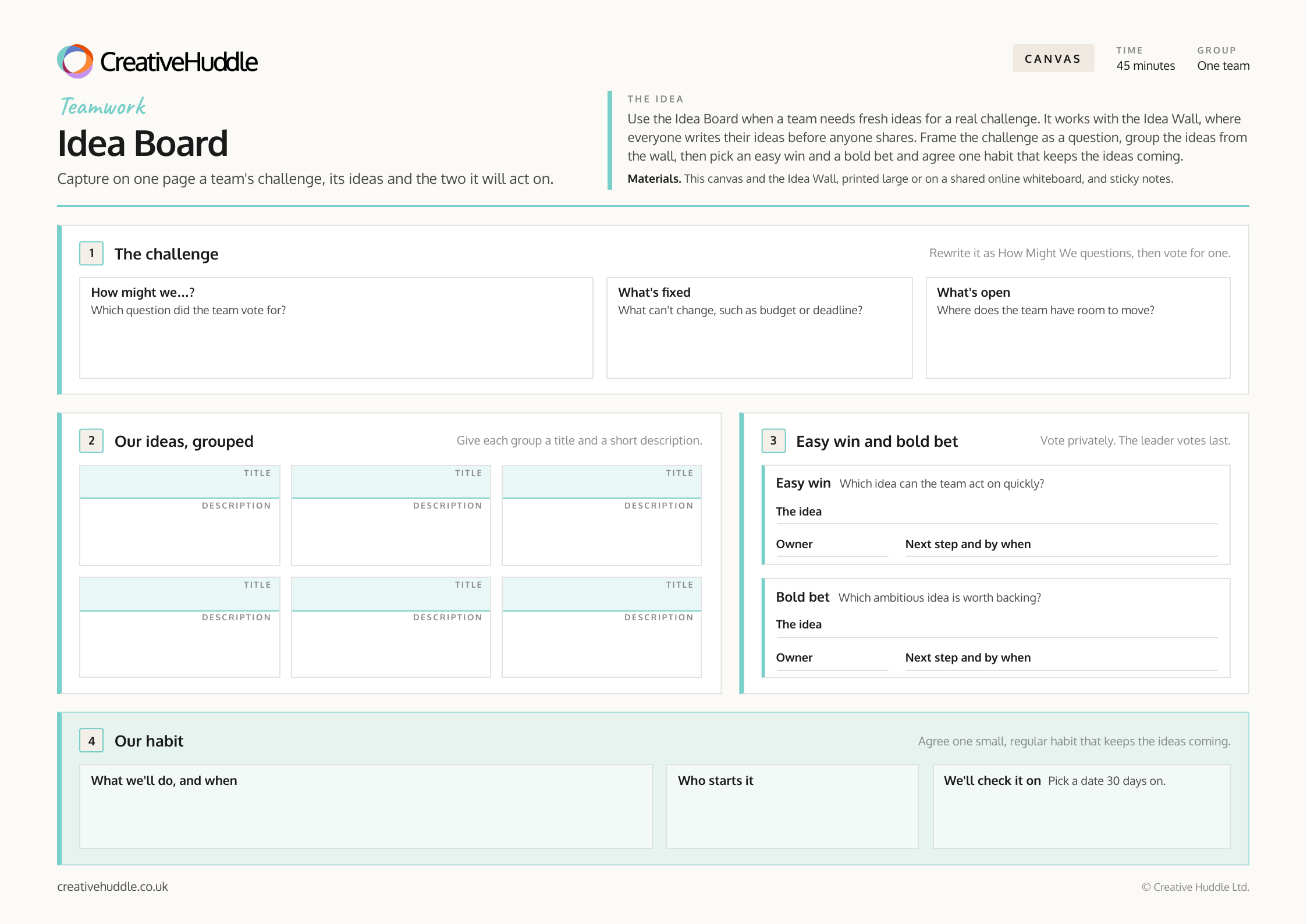
The Idea Board is a one-page record a team builds together while it generates ideas. It has four sections: the challenge, our ideas, easy win and bold bet, and our habit. It suits a live challenge the team can act on, shared in a short note two days before.
Trusted by teams at


Ideas come more easily when a team has a real challenge and a clear way to work on it. The Idea Board gives the team both on a single page.
The challenge comes first. The team rewrites it as How Might We questions and votes for the one to work on, which opens it up to a wider range of answers.
Our ideas follows a simple rule: write alone first on the Idea Wall, then share. Karan Girotra, Christian Terwiesch and Karl Ulrich found that groups who worked alone first and then together produced more and better ideas (Management Science, 2010). The team also keeps going after the first wave slows, because Brian Lucas and Loran Nordgren found later ideas are often more creative (PNAS, 2020).
Easy win and bold bet narrows the ideas to two: one the team can act on quickly and one more ambitious. Everyone votes privately, the leader votes last and each pick gets an owner and a next step. Our habit closes the board with one small, regular behaviour, such as five minutes of silent writing before any idea discussion.
Use the Idea Board when a team wants fresh ideas for a real challenge and a clear choice of what to act on. The team frames the challenge, generates ideas, picks an easy win and a bold bet and agrees one habit, all on a single page.
The team leaves with a completed Idea Board that frames its challenge as a question, captures its ideas, names an easy win and a bold bet with an owner each and records one habit to keep the ideas coming. Everyone has contributed ideas, and the leader has two to act on.

Each step shows how long it takes, the questions or prompts to ask the team and what happens.
Which How Might We question will we work on?
Introduce the challenge. Write what can't change, such as budget or deadline, under What's fixed, and where the team has room to move under What's open. Ask the team to rewrite the challenge as How Might We questions, then vote for one and write it under How might we…?
What could we try?
Ask everyone to write ideas alone in the First wave column of the Idea Wall for four minutes, one per sticky note. When the first wave slows, go again in the Second wave column, because later ideas are often more creative. If people get stuck, ask them to borrow something done brilliantly outside the industry or to look at the challenge as a customer would. Then group similar notes, give each group a title and a short description, and write them in the Our ideas, grouped section.
Which idea can we act on quickly, and which bold idea is worth backing?
Everyone votes privately for an easy win the team can act on quickly and a bold bet worth backing, with the leader voting last. Give each pick an owner and a next step with a date, and write them in the Easy win and bold bet section.
Which habit will keep the ideas coming?
Offer a short list of habits that would keep the ideas coming, such as five minutes of silent writing before any idea discussion. The team ranks them and agrees one in its own words. Write it in the Our habit box with who starts it, and pick a date 30 days on to check it.
The Idea Board canvas and the Idea Wall, printed large or on a shared online whiteboard, and sticky notes
Work through the four sections in order: the challenge, our ideas, easy win and bold bet, and our habit. Share the challenge two days before in a short note, so people arrive with it in mind. In online sessions, get people's eyes off the screen early: Melanie Brucks and Jonathan Levav found that pairs on video generated fewer creative ideas than pairs in person (Nature, 2022).
Add this tool to your session, then build a timed agenda in the Toolkit.
Add to your session
The four-section board to fill in together and the Idea Wall for everyone's ideas, with a worked example of the board.
Add it to your session and the Toolkit builds a timed agenda around it.
Old template parts, hidden. Safe to delete once the new layout is approved.
Capture on one page a team's challenge, its ideas and the two it will act on.
The Idea Board is a one-page record a team builds together while it generates ideas. It has four sections: the challenge, our ideas, easy win and bold bet, and our habit. It suits a live challenge the team can act on, shared in a short note two days before.


Using this tool with a skilled facilitator means that discussions are focused, time is used efficiently, and the group moves toward consensus, making the session productive and impactful.
The canvas is free to download and use however suits you. If you want the full facilitator's guide to run the exercise properly, that sits inside the kit.
Facilitator's guide
The canvas