Give everyone a secret task to complete during the meeting, then reveal who pulled it off.
Everyone gets a small, harmless task to complete during a meeting or away day without anyone noticing. At the end, the team guesses who had which task, then everyone reveals theirs.
Trusted by teams at


Shared laughter helps a team work well. Nale Lehmann-Willenbrock and Joseph Allen filmed real team meetings in two German companies and coded every joke and laugh (Journal of Applied Psychology, 2014). When a joke drew laughter from others, the team was more likely to propose ideas, ask questions and praise each other in the minutes that followed. Supervisors rated teams with more of these shared moments higher, both straight after the meeting and two years later. Humour that nobody laughed along with showed no such link.
Secret Tasks builds in that shared laughter. The tasks are small and harmless, such as using a set phrase in conversation or getting a colleague to say a particular word, so everyone can take part. The guessing round rewards people for watching each other closely, and the reveal gives each person a turn.
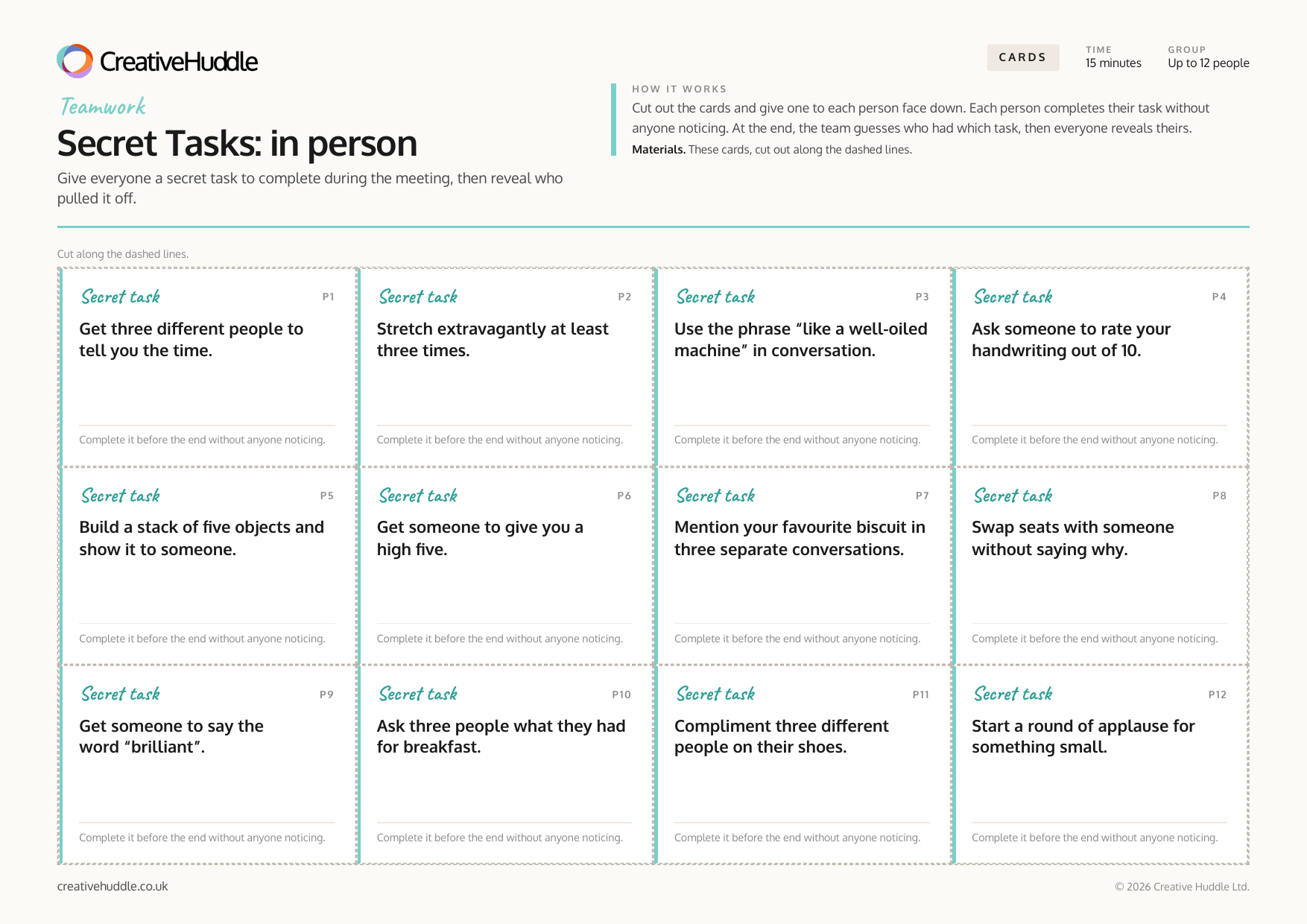
Good tasks for a meeting in person include getting three people to tell you the time and mentioning your favourite biscuit in three separate conversations. Online, try changing your video background halfway through or getting someone to say “good question”.
Use Secret Tasks to run a thread of fun through a longer meeting or an away day. The tasks happen alongside the agenda, and the reveal gives the team a shared laugh to finish on.
The team ends the meeting laughing together, with stories to retell afterwards. Every person gets a turn in the reveal, and the guessing round keeps people paying close attention to each other all day.

Each step shows how long it takes, the questions or prompts to ask the team and what happens.
Can you complete your task before we finish, without anyone noticing?
Give each person a task card face down, or send each task in a private chat message. People keep their task to themselves and complete it at some point in the meeting. Anyone who thinks they've spotted a task makes a note and keeps it to themselves until the end.
Has anyone done anything a little unusual yet?
Run the meeting as planned while the tasks happen in the background. Halfway through, ask the team to guess how many tasks have been completed so far, which reminds everyone to finish theirs.
Who do you think had which task?
At the end of the meeting, ask people to share what they spotted and who they think did it. Each correct guess scores a point for the spotter.
Who pulled it off without being caught?
Go round the team. Each person reads out their task and says whether they completed it. Whoever completed their task with the fewest people spotting it wins the round.
The Secret Tasks cards, printed and cut up, or sent as private chat messages
Print the task cards and cut them up, or copy the tasks into private chat messages for an online meeting. Pick tasks that suit the group and leave out any that could embarrass someone. Run it across a meeting of an hour or more, so people have time to complete their tasks.
Add this tool to your session, then build a timed agenda in the Toolkit.
Add to your session
Twenty-four secret tasks on two pages: 12 cards to cut out for a meeting in person and 12 to send as private messages online.
Add it to your session and the Toolkit builds a timed agenda around it.
Old template parts, hidden. Safe to delete once the new layout is approved.
Give everyone a secret task to complete during the meeting, then reveal who pulled it off.
Everyone gets a small, harmless task to complete during a meeting or away day without anyone noticing. At the end, the team guesses who had which task, then everyone reveals theirs.


Using this tool with a skilled facilitator means that discussions are focused, time is used efficiently, and the group moves toward consensus, making the session productive and impactful.
The canvas is free to download and use however suits you. If you want the full facilitator's guide to run the exercise properly, that sits inside the kit.
Facilitator's guide
The canvas