Surface what gives your work meaning.
Individual reflection exercise: participants explore what drives them, what gives their work meaning, and where those motivations come from.
Trusted by teams at


The title draws on Simon Sinek's Start With Why (2009). Sinek argues that leaders and organisations inspire people when they explain why they do their work before they explain what they do and how. He calls this the "Golden Circle", with why at the centre.
In Find Your Why (2017), written with David Mead and Peter Docker, Sinek turns the idea into a practical process. People share stories of moments from their past that made a strong impression on them, look for the themes running through those stories, and write their why as one sentence: “To ___ so that ___”. The first blank is the contribution they make, and the second is the impact it has.
The three prompts here follow the same thinking in a shorter form. The energised moment gives each person a story, and the impact question points towards the “so that”. Someone might write, “To help people see an idea clearly so that they make it their own.”
Each participant responds privately to three prompts designed to surface the personal dimensions of purpose: what energises them, what they value in their work, and what impact they want to have. This internal work makes the subsequent group discussion richer and more honest, because people have already located their own starting point before being asked to share it.
Use Finding Your Why when you want people to surface what gives their work meaning before any group conversation begins. Three private prompts help each person locate what energises them, what they value, and the impact they want to have.
Participants surface their personal motivators and articulate what gives their work meaning, creating a foundation for the group conversation that follows.

Each step shows how long it takes, the questions or prompts to ask the team and what happens.
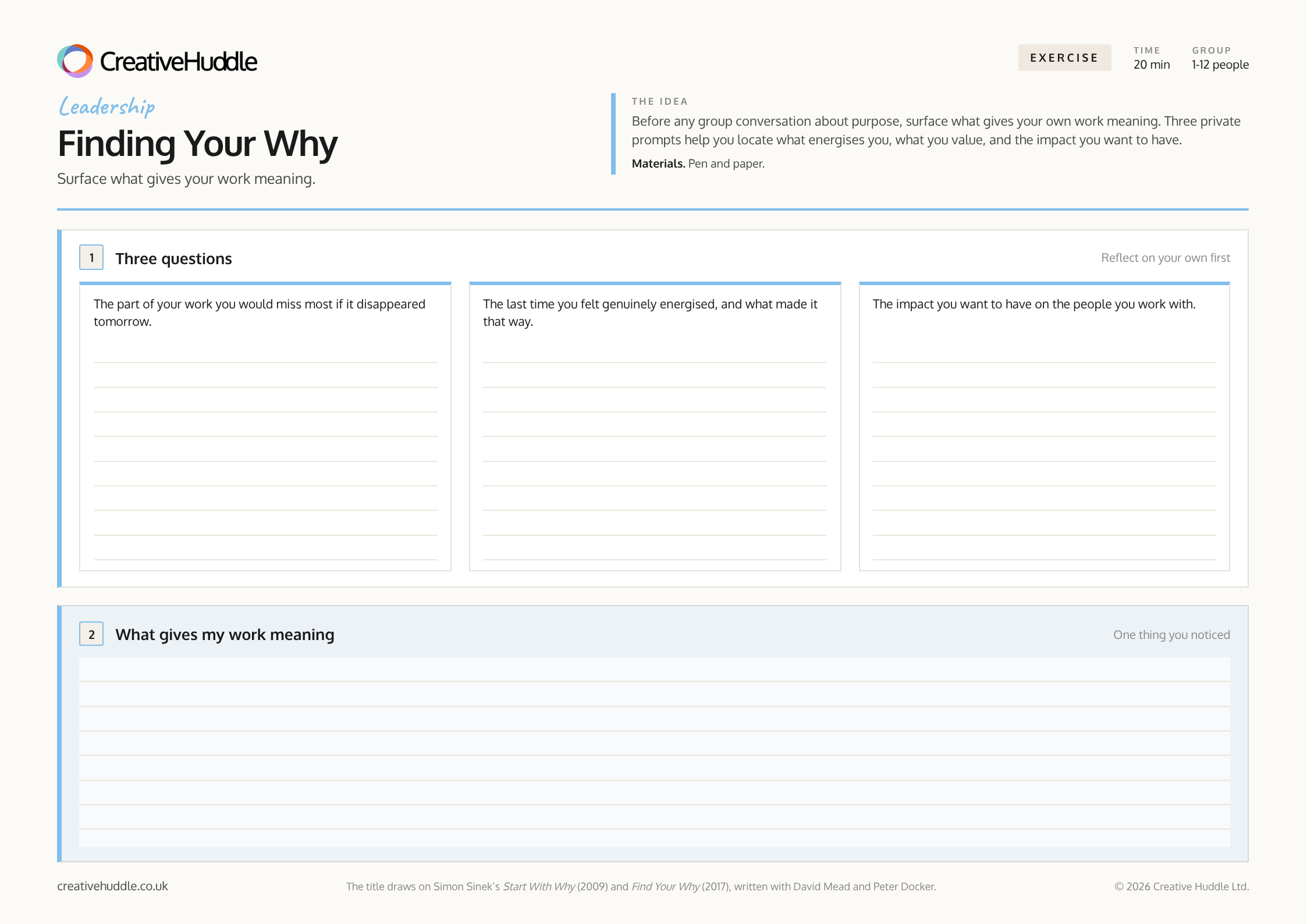
Give people five minutes of quiet individual reflection, with the prompts on a whiteboard or slide. What is the part of your work you'd miss most if it disappeared tomorrow? When did you last feel genuinely energised by what you were doing, and what made it that way? What impact do you want to have on the people you work with?
Invite people to share one thing they noticed. Keep it light, with no pressure to share everything; the aim is to warm the room and give people permission to talk about what matters to them. To draw out quieter people, ask whether anything surprised them, or whether they found one question easier than the others.
Summarise and close the section. This exercise works best when you model openness yourself, so consider sharing a brief example of your own, and give the sharing phase the time it needs, since the quality of later conversations depends on people feeling heard here.
Pen and paper
Give people a few minutes of quiet reflection on what motivates them, then open up a light sharing round before you close. Model openness yourself, and don't rush the sharing.
Add this tool to your session, then build a timed agenda in the Toolkit.
Add to your session
The three-question sheet to fill in on your own, with a worked example on the second page.
Add it to your session and the Toolkit builds a timed agenda around it.
Old template parts, hidden. Safe to delete once the new layout is approved.
Surface what gives your work meaning.
Individual reflection exercise: participants explore what drives them, what gives their work meaning, and where those motivations come from.


Using this tool with a skilled facilitator means that discussions are focused, time is used efficiently, and the group moves toward consensus, making the session productive and impactful.
The canvas is free to download and use however suits you. If you want the full facilitator's guide to run the exercise properly, that sits inside the kit.
Facilitator's guide
The canvas